Skip to content
The Green That Doesn't Exist in Nature — And Why That's the Point

The Green That Doesn't Exist in Nature — And Why That's the Point

A Complete Guide to Green Moissanite Engagement Rings

There are gems the earth makes. And then there are gems the earth couldn't quite pull off — not at this color, not at this price, not with this fire — so humans finished what geology started.
Green moissanite is one of those.
It's not trying to be an emerald. It's not a substitute for a tsavorite or a green tourmaline. It exists in its own category: a stone with physical properties that surpass almost everything found in nature, wearing a color that's maximally saturated, consistently available, and — depending on your light source — genuinely extraordinary.
At Blingflare, we've spent considerable time with green moissanite. Here's everything we know.

What Is Moissanite, Actually?

Silicon carbide (SiC). That's the chemistry. But the story is more interesting than the formula.
In 1893, Henri Moissan found silicon carbide crystals in a meteor crater in Arizona. He initially thought he'd discovered a new diamond deposit. The mineral was later named moissanite in his honor. Natural moissanite is so rare that virtually none of it appears in jewelry — the moissanite you see in rings is lab-created, grown from silicon carbide under controlled heat and pressure conditions.
The resulting stone has properties that are, on paper, almost unfair:
  • Hardness: 9.25 on the Mohs scale. Harder than sapphire. Softer than diamond by less than half a point. Effectively scratch-proof under any normal wearing conditions.
  • Refractive index: 2.65–2.69. Diamond's is 2.42. Moissanite bends light more dramatically, which means more fire — the colored spectral light that flashes from inside the stone.
  • Dispersion: 0.104, versus diamond's 0.044. More than twice the rainbow flash of diamond.
  • Thermal conductivity: High enough that early moissanite routinely confused diamond testers designed to detect heat transfer.
  • Durability: Resistant to scratching, heat, chemicals, and everyday impact in ways that few gemstones can match.
Now add color.

Where the Green Comes From

Natural moissanite is colorless to near-colorless in its purest form. The green you see in green moissanite comes from controlled color treatments applied during or after the growth process — most commonly a thin-film coating or an irradiation treatment that alters how the stone absorbs and reflects light.
This is disclosed, standard practice in the colored moissanite market. The treatment is stable and the color does not fade under normal wear. The question isn't whether the green is "natural" — it isn't, and any honest seller tells you that — the question is whether it's beautiful and durable.
The answer to both is yes.
What the green actually looks like:
Green moissanite doesn't land in one single hue. Depending on the stone's saturation level and the treatment used, you'll see:
  • Forest / deep green — Rich, dimensional, reminiscent of old-growth canopy. Strong saturation. Reads dark in low light, brilliant in direct sun.
  • Sage / gray-green — Desaturated and sophisticated. The color of eucalyptus or sea glass. Pairs beautifully with geometric settings.
  • Teal / blue-green — Where green and blue cross. One of the most requested colors right now. Pairs with both warm and cool metals without clashing.
  • Yellow-green / chartreuse — Energetic, unusual, strongly associated with nature. A genuine statement stone.
  • Mint / light green — Soft, fresh, highly wearable. Looks clean in yellow gold, ethereal in rose gold.

The Firework Cut in Green: Why It Matters More Than You'd Expect

Fire — the dispersion of white light into spectral colors — is moissanite's signature. Its dispersion value is more than double diamond's, which means those rainbow flashes are larger, more frequent, and more visible.
In a colorless stone, this is already remarkable. In a green stone, it becomes something else entirely.
The Firework Cut was developed at Blingflare to maximize the radial movement of light through a gemstone. In a colored moissanite, this facet arrangement doesn't just add brilliance — it creates a kinetic color experience. As the ring moves, the green doesn't stay static. It shifts. Deepens. Lightens. Sparks with yellow-green and blue-green at the edges as the facets catch different angles of light.
Under natural light, a green moissanite in the Firework Cut looks alive in a way that photographing it genuinely struggles to capture. The flat image always undersells it. It has to be seen in motion.

Green Moissanite vs. Green Alternatives

If a buyer is considering green center stones, they have several options. Here's the honest comparison:
Emerald
  • Color: Unmatched. The deep, slightly bluish green of a fine Colombian emerald has no peer.
  • Durability: 7.5–8 hardness, but emerald is heavily included and brittle. It chips and cracks under impact in ways that make it genuinely risky in daily-wear settings.
  • Price: Natural, high-quality emeralds at >1ct are expensive — often more expensive than comparable diamonds. Lab emeralds are improving but still less consistent.
  • Verdict: Magnificent when protected. Less practical for everyday rings without a protective bezel.
Tsavorite Garnet
  • Color: Vivid, bright green. Often described as cleaner and more brilliant than emerald.
  • Durability: 6.5–7.5 hardness. Softer than sapphire or moissanite.
  • Price: Moderate at smaller sizes, expensive at larger sizes. Large fine tsavorites are genuinely rare.
  • Verdict: Beautiful. Increasingly popular. Limited size availability.
Green Tourmaline
  • Color: Wide range — from light mint to deep chrome green.
  • Durability: 7–7.5 hardness. Acceptable but not ideal for high-wear settings.
  • Price: Moderate. More available than tsavorite.
  • Verdict: Underrated stone with genuine versatility. Worth considering.
Green Sapphire
  • Color: Typically more muted, olive-to-teal range. Very few naturally vivid greens.
  • Durability: 9 hardness. Excellent.
  • Price: Varies significantly by origin and saturation.
  • Verdict: Very durable, but the color range is narrower and less saturated than moissanite at comparable prices.
Green Moissanite
  • Color: Consistent, vivid, with wide saturation options across teal, forest, sage, and mint.
  • Durability: 9.25 hardness. Second only to diamond.
  • Fire: More than double diamond's dispersion. Spectacular in motion.
  • Price: Significantly more accessible than natural alternatives at larger sizes.
  • Verdict: The practical choice for someone who wants vivid green, exceptional durability, and serious size at a real-world budget.

Metal Pairing for Green Moissanite

Green is one of the most metal-flexible colors in gemstone jewelry because it exists on a warm-to-cool spectrum.
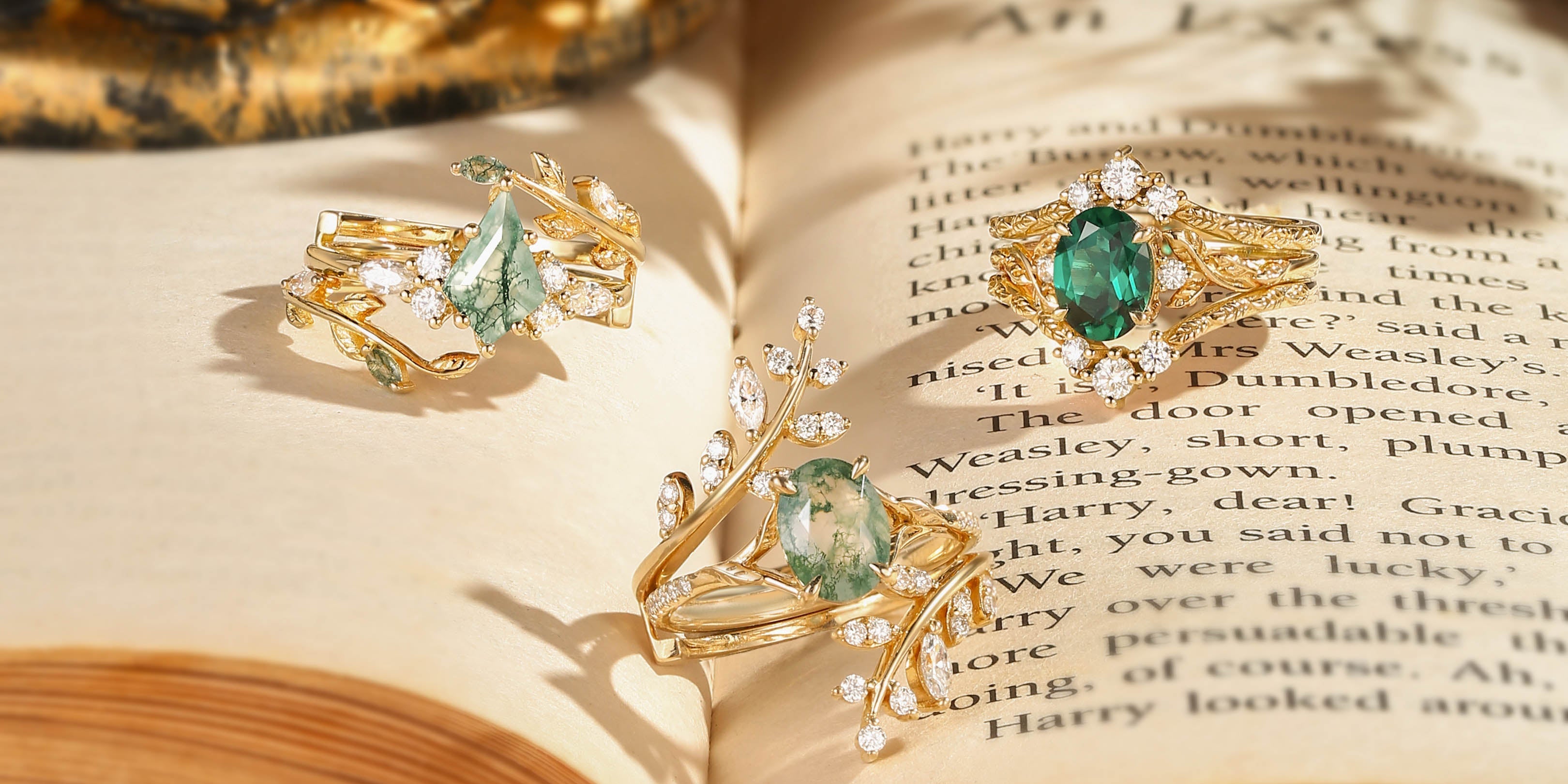
  • Yellow gold — The warmest pairing. Creates a jewel-toned, maximalist effect reminiscent of vintage botanical illustrations. Forest green and yellow-green hues particularly benefit from yellow gold's warmth.
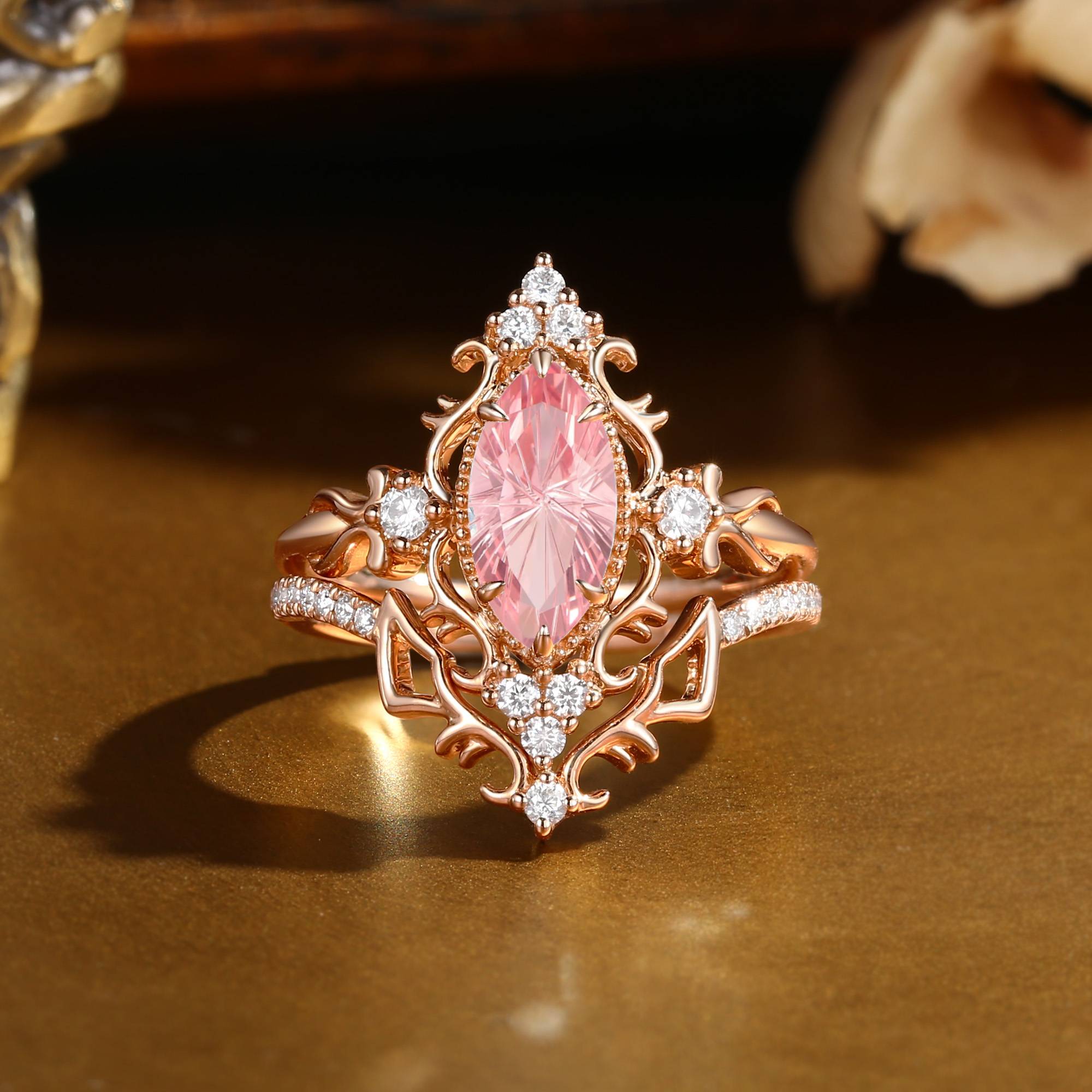
  • Rose gold — The unexpected pairing. Pink and green are complementary colors, and the combination creates a visual tension that's genuinely arresting. Works best with sage, teal, and mint greens.
  • White gold / platinum — The coolest and most modern. Maximizes contrast. Teal and mint greens look clean and architectural in white metal. Creates a contemporary, almost editorial effect.
  • Vintage-style yellow or mixed metal — Our recommendation for buyers drawn to Blingflare's natural design language. The leaf and vine motifs in our nature-inspired settings pair with green moissanite in a way that feels genuinely cohesive — like the ring was grown rather than assembled.

Who Chooses Green Moissanite?

Honestly? People who've decided that their ring should reflect who they are rather than what a ring is "supposed" to look like.
Green is not the conventional choice. That's precisely why it resonates. The buyers who come to Blingflare for green moissanite tend to be:
  • Drawn to nature — forests, plants, the color of living things
  • Interested in sustainability and making choices that align with their values
  • Confident enough in their taste to go against the expected
  • Practical enough to want a stone that handles daily life without anxiety
They don't want to be asked "is that an emerald?" They want people to ask "what is that?" — and then explain, because the explanation is interesting.
Green moissanite in the Firework Cut is an interesting ring. An intentional ring. A ring that took some thought to find and deserves to be found by the person it was meant for.
We'll help you find it.
Previous Post Next Post