The Case for Choosing a Pink Sapphire Engagement Ring
There's a moment that happens when someone first sees a pink sapphire in natural light.
It's not the same as seeing a diamond. A diamond asks you to look at it — to study its brilliance, count its facets, acknowledge its performance. A pink sapphire does something different. It pulls you in. It glows like something warm and alive, like a sunset caught inside stone.
That's not an accident. It's corundum — the same mineral family as the blue sapphire — but carrying iron and chromium in a ratio that tilts the color toward blush, rose, magenta, or deep raspberry, depending on where it was formed and how it was cut. Chemistry made visible.
At Blingflare, we think of pink sapphires the way we think about all great gems: not as alternatives to something "better," but as stones with a language entirely their own.
The Spectrum Within "Pink"
Not all pink sapphires look alike. That's the first thing to understand — and the most freeing.
The GIA grades pink sapphires across a wide saturation range, from very light pink (sometimes called "blush sapphire") through medium-vivid pink to deep pink that begins to border on ruby. The distinction between "pink sapphire" and "ruby" is technically a chromium threshold — once a stone crosses a certain saturation of red, it becomes a ruby. But in the middle of that range lives a world of colors most people have never fully explored.
- Light blush pink — Quiet. Romantic. Catches light without demanding it. Ideal for minimalist settings, east-west orientations, and buyers who want something that whispers rather than announces.
- Medium rose pink — The most commercially popular range. Rich enough to read clearly from across a room, soft enough to wear with everything. Pairs beautifully with rose gold and yellow gold alike.
- Vivid hot pink / magenta — Saturated. Confident. These stones have the kind of color that stops conversations. They belong in settings designed to celebrate them — solitaires, bezel mounts, architectural designs.
- Pinkish-purple / orchid — A rarer shift where the stone contains enough of both chromium and iron to create a color that's genuinely unusual. Less predictable to photograph, extraordinary in person.
At Blingflare, we carry pink sapphires across this entire range, because we believe the right stone isn't always the most famous one — it's the one that matches how you see the world.
Lab-Grown Pink Sapphires: The Honest Conversation
The jewelry industry has spent decades treating "natural" as a synonym for "better." We don't.
Lab-grown sapphires are physically, chemically, and optically identical to mined sapphires. Same hardness (9 on the Mohs scale — the second hardest gemstone after diamond). Same refractive index. Same mineral composition. The only difference is where the crystal formation happened: inside the earth over millions of years, or inside a controlled chamber over a matter of weeks.
What lab-grown does differently:
- Color availability — Certain saturations that are extremely rare in nature can be produced consistently in lab conditions. The vivid, evenly-distributed hot pink that buyers dream about? More reliably available lab-grown.
- Clarity — Lab-grown sapphires tend to have fewer inclusions. Eye-clean stones are the norm rather than the exception.
- Price — Meaningfully lower than natural for comparable color and size, which means a larger stone or more elaborate setting within the same budget.
- Ethics — Full supply chain transparency. No small-scale artisanal mining with uncertain labor conditions.
We'll never tell you that lab-grown is the only right choice. Some buyers want a natural stone with a geological story — and those exist in our collection too. But we will always tell you exactly what you're looking at and let you decide with complete information.
The Firework Cut Difference
Most pink sapphire jewelry you'll see online was designed around the stone — the setting accommodates whatever shape was available. At Blingflare, we developed the Firework Cut specifically to address what we think is the biggest lost opportunity in colored gemstone jewelry: wasted light.
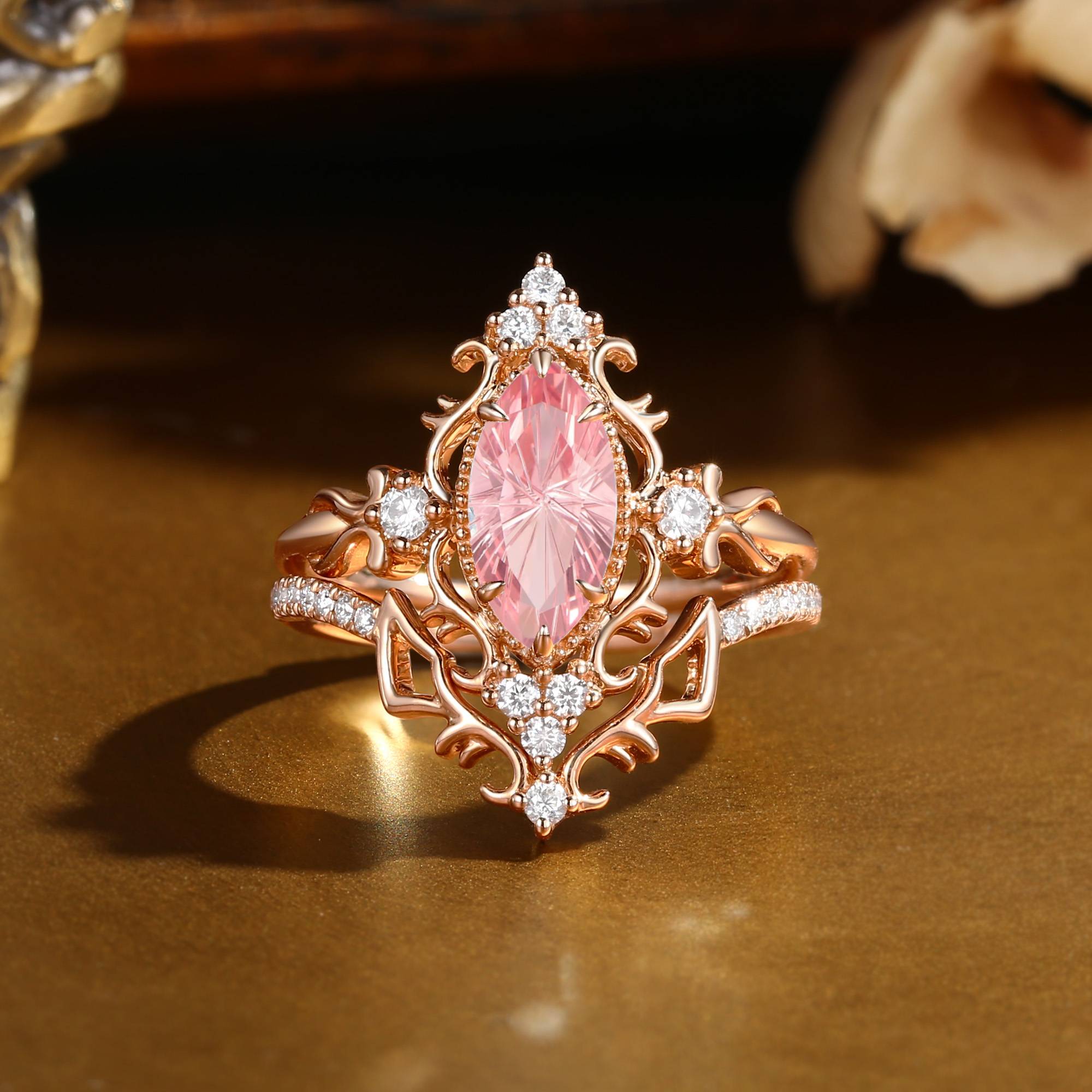
Traditional oval and round cuts direct brilliance upward. The Firework Cut uses a proprietary facet arrangement that disperses light in radial patterns — literally mimicking the way fireworks expand outward from a center point. In a colored stone, this has a specific consequence: the color doesn't sit in the center and fade. It moves.
In a pink sapphire, this means the blush doesn't concentrate at the table and die at the girdle. The color rotates, shifts, catches, and releases as the ring moves. It's the difference between a photograph of a sunset and watching it happen.
If you've seen other pink sapphire rings and thought "beautiful in pictures, a little flat in person" — this is what they were missing.
How Pink Sapphires Wear: The Practical Reality
This matters more than people say.
An engagement ring is worn every day. It goes in water (sometimes), against countertops (often), into gym bags, through seasons, across decades. A stone needs to be able to handle that reality.
Pink sapphire is one of the most durable gemstones available:
- Hardness: 9/10 on the Mohs scale. Only diamond is harder. It will not scratch under normal wear.
- Toughness: No cleavage planes that make it vulnerable to impact (unlike emerald, which can chip with a hard knock).
- Heat resistance: Stable across the temperature ranges a ring encounters in daily life.
- Fading: High-quality sapphires — particularly lab-grown — do not fade in light. What you buy is what you wear in twenty years.
For context: moissanite and diamond are the only other stones that outperform sapphire on durability for everyday wear. Everything else — morganite, emerald, opal, tanzanite — is softer and requires more careful handling.
Pink Sapphire and Metal: Finding the Pair
Metal choice dramatically affects how a pink sapphire reads.
- Rose gold — The natural pairing. Rose gold enhances the warmth in light-to-medium pinks and creates a monochromatic harmony that reads as very intentional. Softer and more romantic.
- Yellow gold — Unexpected and brilliant. Yellow gold beneath a pink sapphire creates warmth and vibrancy. The contrast between the richness of the gold and the freshness of the pink is visually striking in a way rose gold isn't.
- White gold / platinum — Maximizes the color contrast. The stone reads cooler and more saturated. Excellent choice for vivid pinks and magenta-range stones where you want the color to be the entire statement.
- Two-tone — For buyers who don't want to choose: rose gold prongs holding the stone with a white gold or platinum band gives you the color warmth at the point of greatest visual attention while keeping the band clean and versatile.
Wearing Pink Sapphire in 2026: What the Moment Feels Like
Colored center stones have been building for years, but something shifted recently. Pink specifically moved from "romantic choice" to "considered choice." The buyers who come to Blingflare for pink sapphires aren't following a trend — they're making a deliberate statement about what they value.
They're choosing a stone with more character than a colorless diamond. More rarity than a blue sapphire at that color depth. More durability than the morganites or rose quartz that offer a similar hue. They're choosing pink because pink — saturated, confident, absolutely unapologetic — is exactly what they want on their hand for the next fifty years.
We can help you find that stone.
→ Explore Blingflare's Pink Sapphire Collection