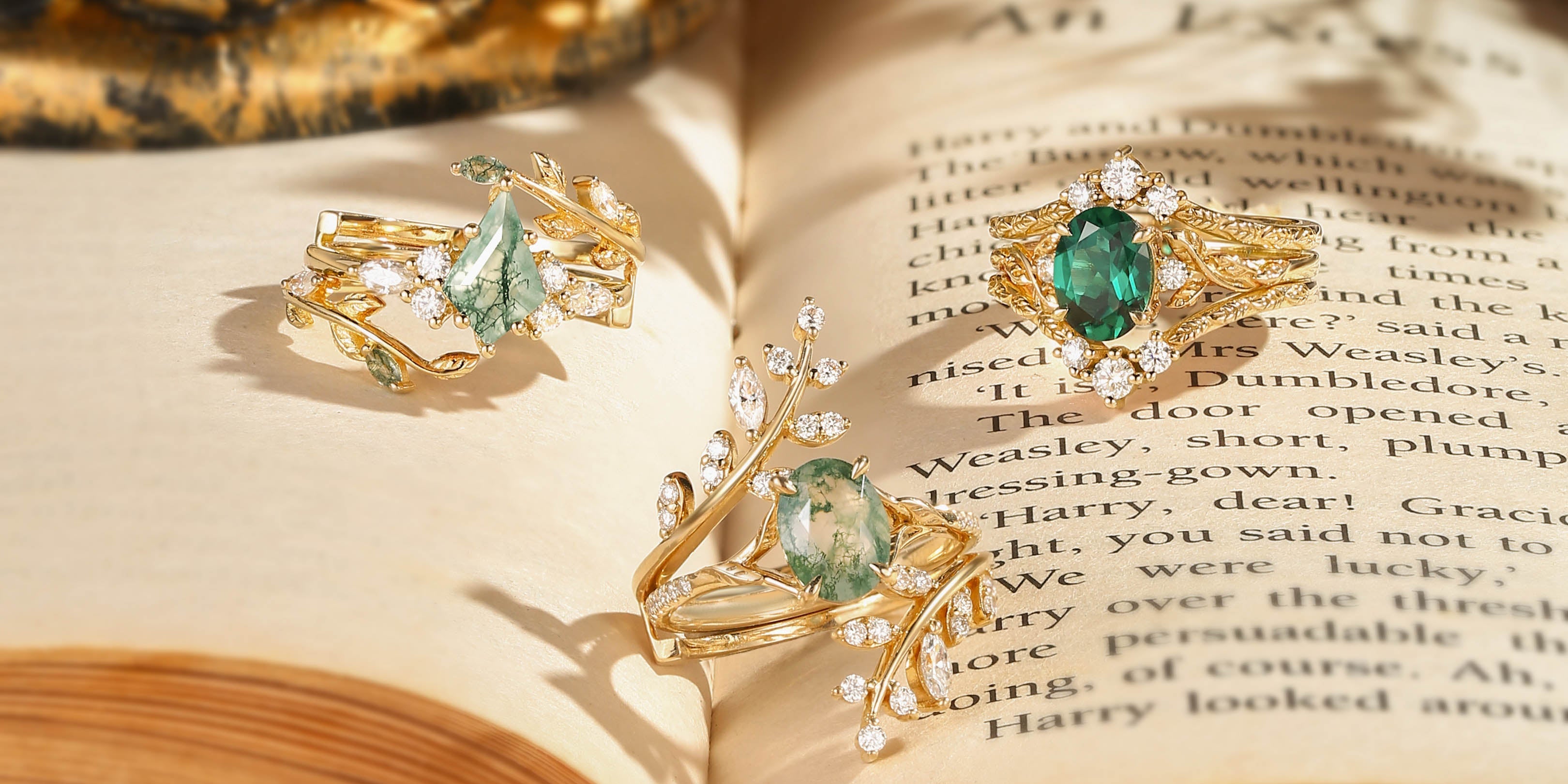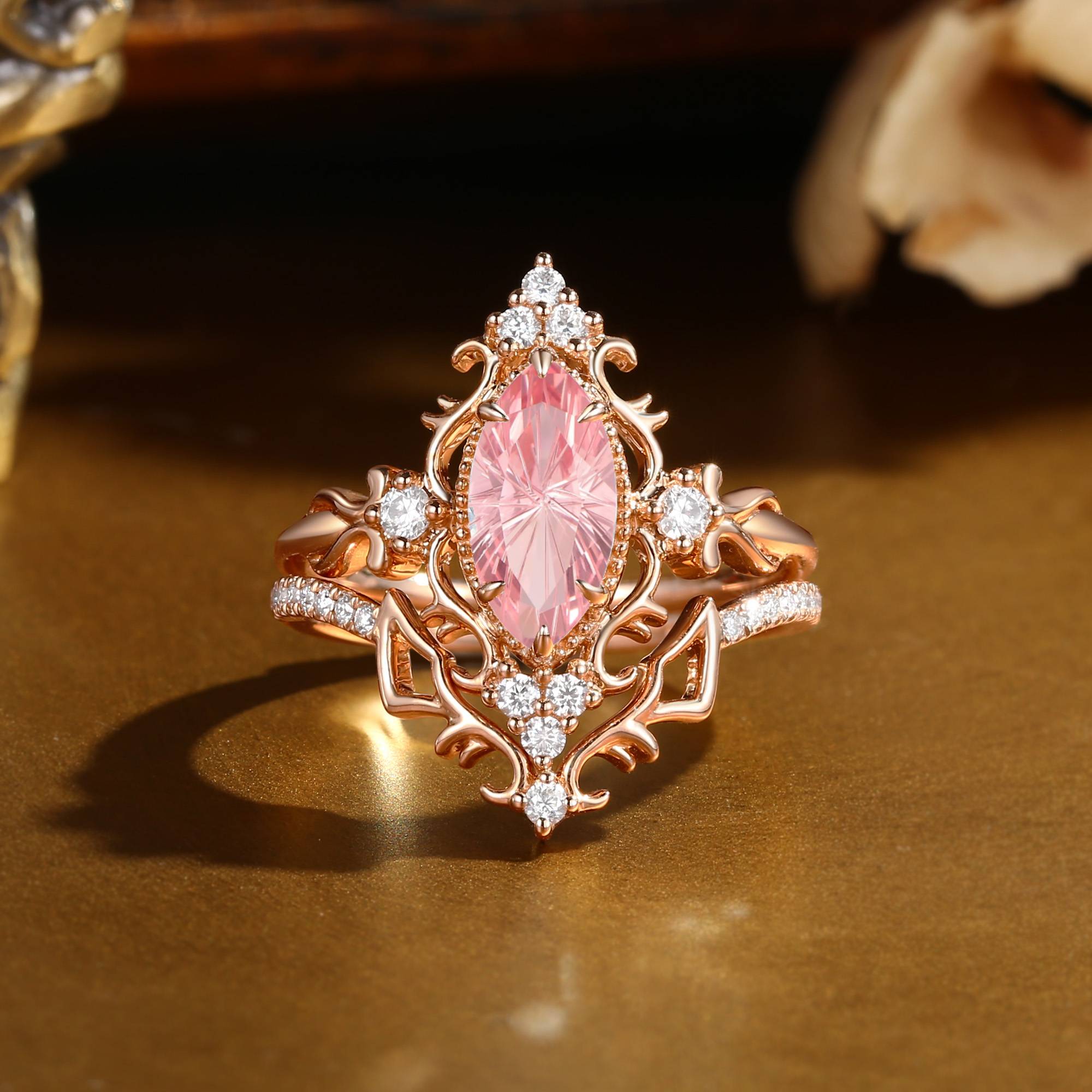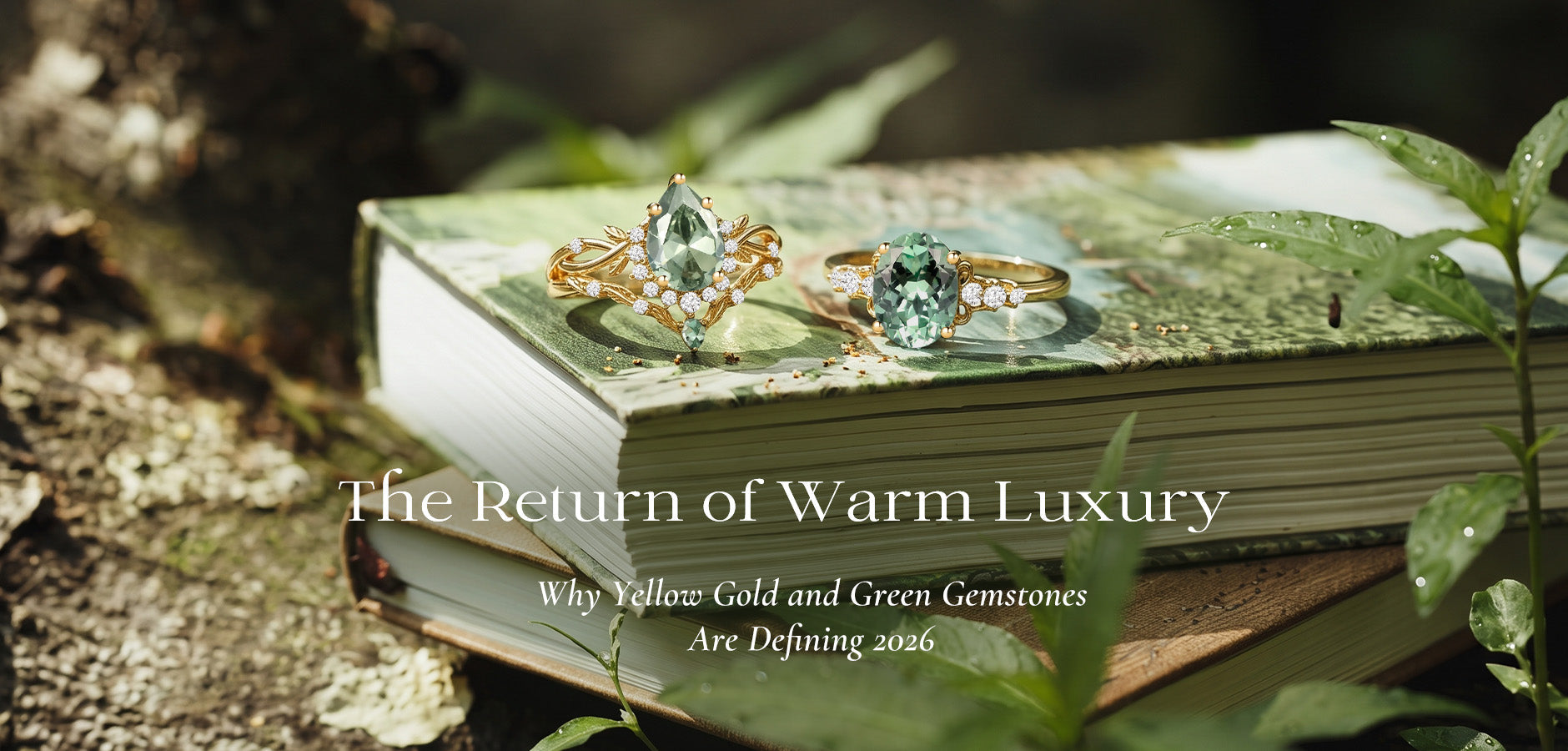
For the past decade, white gold and platinum have dominated the engagement ring conversation — sleek, cool, and effortlessly "bridal." But if you've been scrolling through Vogue's 2026 trend roundups or flipping through Harper's Bazaar's latest jewelry editorials, you've probably noticed a shift: warm metals are back, and they're louder than ever. Butter Yellow has been crowned a defining color of the season, earth-toned palettes are flooding the runways, and yellow gold engagement rings are suddenly the pièce de résistance of every "what's next in jewelry" piece. Pair that with the quiet rise of nature-inspired gemstones — especially green sapphire — and you have the makings of a trend that feels less like a flash-in-the-pan and more like a full cultural reset.
At BlingFlare, we've been betting on this shift for a while. Our entire design philosophy orbits around natural beauty, botanical motifs, and our signature Firework Cut — gemstones engineered to scatter light like sparks against warm metal. If you're wondering whether yellow gold is worth the leap in 2026, or how to pair it with a stone that feels fresh rather than fussy, you're in the right place. Let's break it all down.
Table of Contents
- Why Warm Metals Are Having a Moment
- Yellow Gold × Green Sapphire: The New Power Pairing
- Yellow Gold vs. White Gold: Which Style Is Yours?
- The BlingFlare Warm Gold Collection
- How to Style Yellow Gold in 2026
- FAQ
Why Warm Metals Are Having a Moment
Start with the fashion pages. Vogue declared Butter Yellow one of the defining shades of 2026, describing it as "sunlight captured in pigment." Harper's Bazaar followed suit, spotlighting warm metals across their spring jewelry features — not as a nostalgic callback to the '90s gold boom, but as something decidedly forward-looking. The language has shifted: warm tones are no longer "vintage"; they're "editorial." They're the new elevated.
That editorial energy has bled directly into jewelry search behavior. Pinterest reports that "yellow gold ring" searches are up roughly 40% year-over-year — and the boards aren't filled with chunky, old-school signet styles. They're delicate, nature-forward, textured. Rings that look like they grew out of a garden trellis. Rings that feel alive.
There's a psychological thread here, too. After years of pandemic-era minimalism and the sterility of all-white-everything, consumers are gravitating toward objects that feel warm — in temperature, in story, in craft. A yellow gold band catches candlelight differently than platinum. It photographs like amber. It feels like something passed down, even when it's brand new. Warm luxury isn't about going back. It's about bringing feeling into fine jewelry again.
Which brings us to the gemstone pairing that's making this whole trend click…
Yellow Gold × Green Sapphire: The New Power Pairing
On the color wheel, yellow and green sit right next to each other — neighbors, not opposites — and that adjacency creates something interesting. The warmth of yellow gold amplifies the depth of a green sapphire without competing with it. Where a diamond on white gold reads as "classic bridal," a green sapphire on yellow gold reads as botanical luxury. It's editorial. It's unexpected. It photographs like a mood board come to life.
Green sapphire also has practical going for it that other green stones don't. At 9.0 on the Mohs hardness scale, it's nearly as durable as diamond — significantly tougher than emerald, which sits around 7.5–8 and is notoriously prone to cracking. Emeralds are dramatic; green sapphires are livable. They have the depth of a forest canopy without the high-maintenance reputation. They feel less "black-tie gala" and more "golden-hour garden proposal" — which, for a growing number of couples, is exactly the energy they want.
The style tags are stacking up: modern vintage, royalcore, botanical, editorial. Designers are moving away from the safe diamond-on-white-gold formula toward combinations that tell a story. And few combinations tell a story as vividly as a vivid green stone cradled in warm, textured gold.
Here's how BlingFlare is bringing that vision to life:


Yellow Gold vs. White Gold: Which Style Is Yours?
This is the question we hear most often at BlingFlare — and the honest answer is that neither metal is universally "better." It's a style decision, and the right choice depends on what you want your ring to say.
White gold has spent the last fifteen years as the default bridal metal. It's cool, it's minimal, it lets a diamond do all the talking. If your aesthetic leans clean lines and icy brilliance, white gold still has a strong case.
But if you're drawn to warmth, texture, and a ring that photographs like it belongs in a editorial spread — yellow gold is the 2026 move. It pairs beautifully with colored gemstones, flatters a wider range of skin tones than most people assume, and carries a sense of craft that feels intentional rather than safe.
| Yellow Gold | White Gold | |
|---|---|---|
| Vibe | Warm, romantic, editorial | Cool, minimal, classic |
| Best for skin tone | Warm / olive / dark undertones | Fair / cool undertones |
| 2026 Trend Alignment | ★★★★★ | ★★★☆☆ |
| Pairs best with | Green, blue, earth-tone gems | Diamond, white sapphire |
And here's the thing most style guides won't tell you: you don't have to pick just one. Mixed-metal stacking is one of the defining jewelry looks of 2026. Start with a yellow gold engagement ring as your anchor piece, then layer in a thin white gold band or a rose gold accent ring. The contrast feels modern without trying too hard — like you didn't plan it, but you absolutely did.
The BlingFlare Warm Gold Collection
BlingFlare was built around the idea that fine jewelry shouldn't feel like it came out of a factory mold. Every piece in our yellow gold collection is designed with botanical detailing — leaf motifs, filigree textures, organic curves — and set with gemstones cut to maximize life rather than just brilliance. Our Firework Cut, developed in-house, scatters light in a way that mimics candlelight on water: soft, shifting, impossible to look away from.
When we design in yellow gold specifically, we're thinking about how the metal warms the stone. A green sapphire that might read cool under white platinum suddenly glows with an inner lantern light against 14K or 18K gold. It's a different ring entirely — warmer, more dimensional, more you. Here are a few pieces from the collection that capture the mood best:


How to Style Yellow Gold in 2026
Stacking is the move. A single yellow gold engagement ring makes a statement; add a textured enhancer or a slim stacking band and you've got a curated stack that photographs like a jewelry editorial. BlingFlare's enhancer rings are designed to nest directly against our engagement settings, so you get that layered look without any gap or awkward alignment. For a 2026 twist, try mixing one yellow gold piece with a thin rose gold band — the warmth-on-warmth effect is quietly luxurious.
Know your skin tone cheat sheet. Warm and olive undertones? Yellow gold will make your skin look like it's lit from within — lean in. Cool undertones? A higher-karat yellow gold (18K) has enough richness to complement without clashing. Deep skin tones? Yellow gold is your secret weapon — it amplifies the natural warmth of melanin beautifully and photographs like absolute fire. Don't overthink it; try it on and let your wrist decide.
Scene-by-scene styling. For the office, a slim yellow gold band with a small green sapphire keeps things polished without shouting. For a garden party or outdoor brunch, let the textures do the talking — filigree and botanical details shine in natural light. For bridal editorials or engagement photos, pair your yellow gold set with an earth-tone palette: sage, cream, terracotta. The ring becomes the exclamation point of every shot.
Yellow gold isn't your grandmother's jewelry — it's 2026's most editorial choice.
Related Reads
- How to Choose the Perfect Ring Enhancer for Your Engagement Ring
- Green Moissanite vs. Green Sapphire: Which Green Stone Is Right for You?
- The Fireworks Cut: A Gemstone with a Thousand Stories to Sparkle
Is yellow gold coming back in style in 2026?
Absolutely. Yellow gold has been steadily climbing for several seasons, and 2026 is the year it fully reclaims the spotlight. Pinterest reports a ~40% year-over-year increase in "yellow gold ring" searches, and major fashion publications like Vogue and Harper's Bazaar are calling warm metals the defining jewelry story of the year. It's not a brief nostalgia moment — it's a real cultural shift toward warmth, texture, and craft in fine jewelry.
What gemstone looks best with yellow gold?
Yellow gold is remarkably versatile, but it truly shines with green and earth-tone gemstones. Green sapphire, green moissanite, teal sapphire, and warm-toned morganite all create beautiful contrast against the metal's warmth. Blue sapphires also look stunning — the warm-cool tension is very editorial. If you want a classic look, a warm-white diamond in a yellow gold setting feels rich and intentional rather than safe.
How is green sapphire different from emerald?
They're both beautiful green gemstones, but they behave very differently. Emerald (a variety of beryl) sits around 7.5–8 on the Mohs scale and is naturally included and brittle — it requires careful setting and gentle wear. Green sapphire, at 9.0 Mohs, is substantially harder and more resilient. Visually, emerald tends toward a deeper, more saturated green with visible inclusions (the "jardin"), while green sapphire offers a softer, more luminous green that reads as natural and botanical rather than formal.
Does yellow gold suit all skin tones?
Short answer: yes. Yellow gold is one of the most universally flattering metals, though it expresses differently across skin tones. Warm and olive undertones get a sun-kissed glow; cool undertones can opt for 18K gold, which has a richer, softer yellow that complements without clashing; deep skin tones look absolutely luminous — yellow gold amplifies melanin beautifully. The best test is to try it on in natural light and see how it makes you feel.
Is 14K or 18K yellow gold better for engagement rings?
It depends on your priorities. 14K yellow gold is harder and more scratch-resistant, which makes it a practical choice for active lifestyles and intricate designs with lots of fine detailing. 18K yellow gold has a richer, deeper yellow tone and a slightly softer, more luxurious feel — it photographs beautifully and is the traditional choice for heirloom-quality pieces. Both are excellent for engagement rings; 14K leans durable, 18K leans sumptuous.
Where can I find yellow gold engagement rings with green sapphire?
Right here. BlingFlare's yellow gold collection features multiple green sapphire engagement rings — from botanical filigree settings to our signature Firework Cut designs. You can also explore the full green sapphire collection and filter by metal color. Every ring is crafted to order, so you can customize metal type, stone, and sizing. Chat with our team at blingflare.com or DM us on Instagram for personalized recommendations.
Have questions about our yellow gold collection? Chat with our team at blingflare.com or message us on Instagram.