Most engagement ring cuts are engineered for one audience: the person looking straight down at the stone. Every facet is calibrated to return light upward through the table, maximizing brilliance from a single vantage point. It is a rational approach. It is also, from a design standpoint, incomplete.
The Firework Cut — a proprietary modification developed by BlingFlare — changes that equation. By altering the pavilion facet angles, it disperses light across a wider horizontal angle rather than directing it primarily upward. The result: the stone catches light from more directions and shows visible flash to people standing beside the wearer, not just to the person looking directly down at it. In colored gemstones — where the stone's hue rides the scattered light — the effect is particularly dramatic. The ring announces itself from across a room.
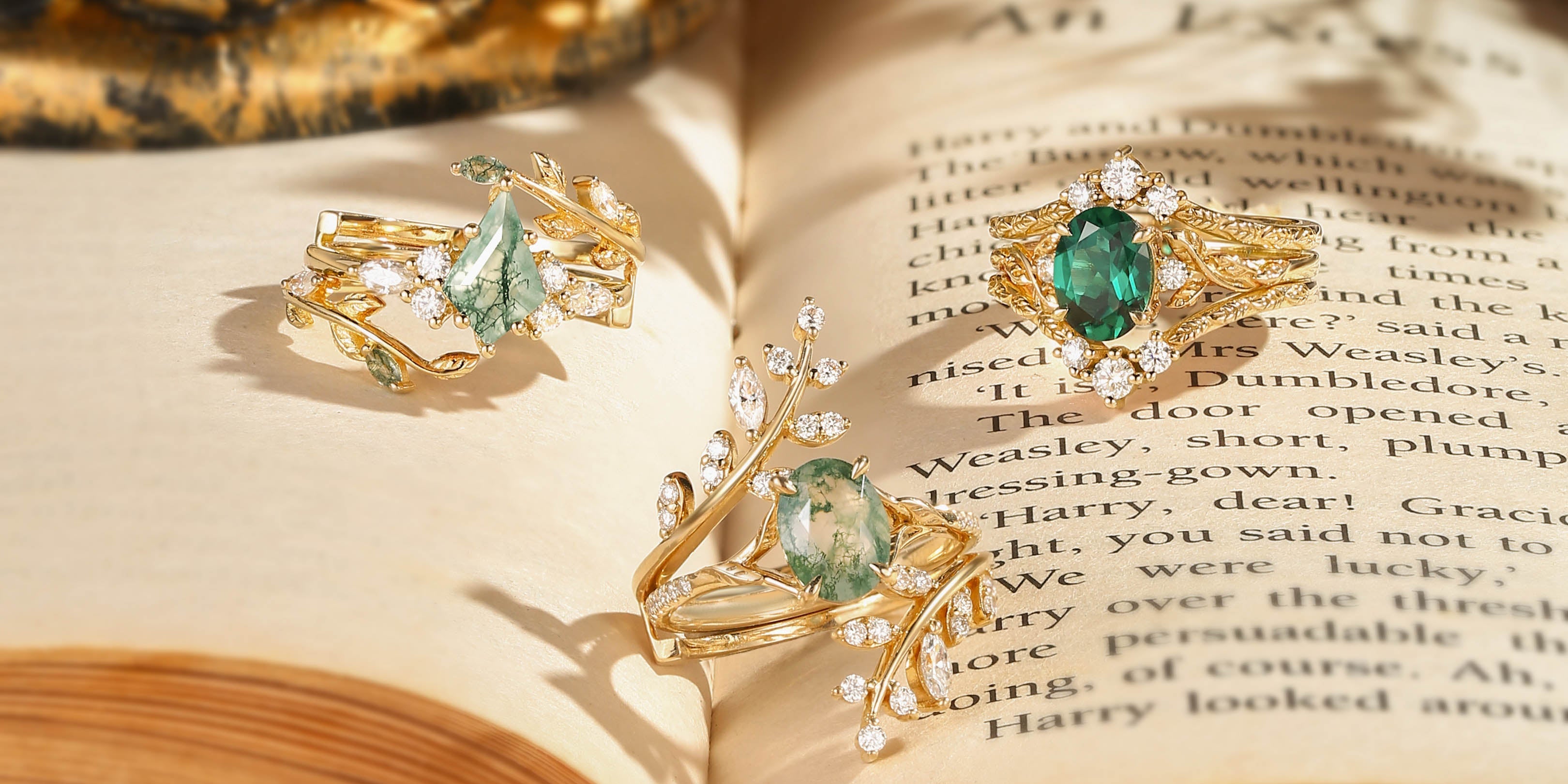
At BlingFlare, the Firework Cut is available in green sapphire, cornflower sapphire, lab ruby, and padparadscha — set in solid gold with nature-inspired botanical metalwork. This guide covers what the cut is, how it works, and which colors carry it.
Table of Contents
- What Is the Firework Cut?
- How Firework Faceting Changes Light Behavior
- Firework Cut vs. Standard Cut
- Green Firework Cut — The Forest Bride's Flash
- Blue Firework Cut — Vivid Cornflower, Wider Reach
- Other Colors — Ruby & Padparadscha Firework Cut
- How to Choose a Firework Cut Ring
- FAQ
What Is the Firework Cut?
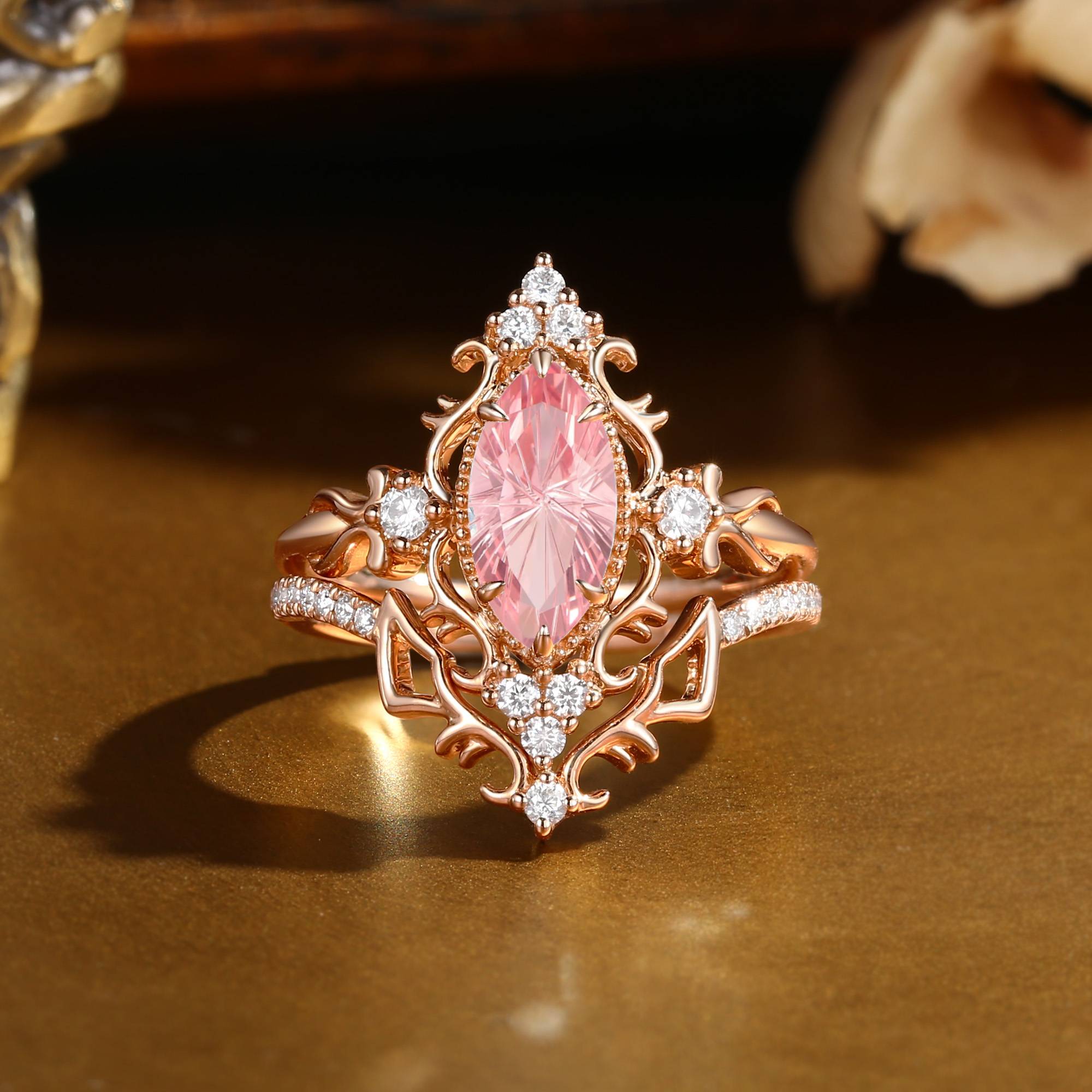
The Firework Cut is a modified fancy cut — applied to marquise and pear-shaped stones — that redistributes the stone's light return pattern. Where a standard cut directs most reflected light upward through the table (the flat top surface of the stone), the Firework Cut angles a significant portion of that light outward, across a broader horizontal plane.
Think of the difference between a spotlight and a lantern. A standard cut is a spotlight: intense, focused, visible from one direction. The Firework Cut is closer to a lantern: the light travels outward in multiple directions, filling the space around the stone rather than projecting through a single axis.
The name is literal. In low light or side-angle illumination, the stone scatters colored flashes that resemble the radial burst of a firework — light radiating outward from the center of the stone in multiple directions, rather than reflecting straight back up.
How Firework Faceting Changes Light Behavior
A gemstone's cut determines how light enters, reflects internally, and exits. In a standard cut, the pavilion facets (the angled surfaces below the girdle) are calculated to reflect light back upward through the table. The Firework Cut modifies these pavilion angles, causing a portion of the light to exit through the crown's side facets — the surfaces facing outward, toward the viewer's peripheral position.
The practical consequences:
- Side-angle visibility: People standing next to the wearer see flash and color that would be invisible in a standard cut. The ring is active from 360 degrees, not just from above.
- Movement-responsive sparkle: As the wearer's hand moves, the angle of incident light changes continuously. The Firework Cut's wider return window means the stone catches and releases light more frequently during natural hand movement — more flashes per gesture.
- Color amplification: In colored stones, the light that exits through side facets carries the stone's body color. A green sapphire throws green light, cornflower sapphire throws blue, ruby throws red. The color becomes ambient, not just directional.
- Low-light performance: In candlelight, restaurant lighting, or evening settings — where overhead illumination is weak — the Firework Cut's wider return window captures more of the available light. The stone stays active in conditions where standard cuts go quiet.
Firework Cut vs. Standard Cut
| Property | Standard Cut | Firework Cut (BlingFlare) |
|---|---|---|
| Primary Light Direction | Upward through table | Upward + lateral (wider horizontal dispersion) |
| Side-Angle Visibility | Limited — mostly visible from above | High — visible from multiple angles |
| Movement Response | Flashes at specific angles | More frequent flashes during hand movement |
| Color Projection | Color contained within stone body | Color rides dispersed light outward |
| Low-Light Performance | Reduced in diffuse lighting | Maintains activity in ambient light |
| Best Viewing Position | Directly above | Any position — above, beside, across |
The Firework Cut does not replace the standard cut — it extends it. A standard cut optimized for overhead brilliance is the right choice for someone who wants maximum brightness from a single viewing angle. The Firework Cut is the right choice for someone who wants the stone to be active and visible from every angle, in every lighting condition, during every gesture.
Green Firework Cut — The Forest Bride's Flash
Lab-grown green sapphire scores 9.0 on the Mohs scale — second only to diamond and moissanite among engagement ring stones. It handles daily wear without special maintenance, with traceable origin and consistent color saturation.
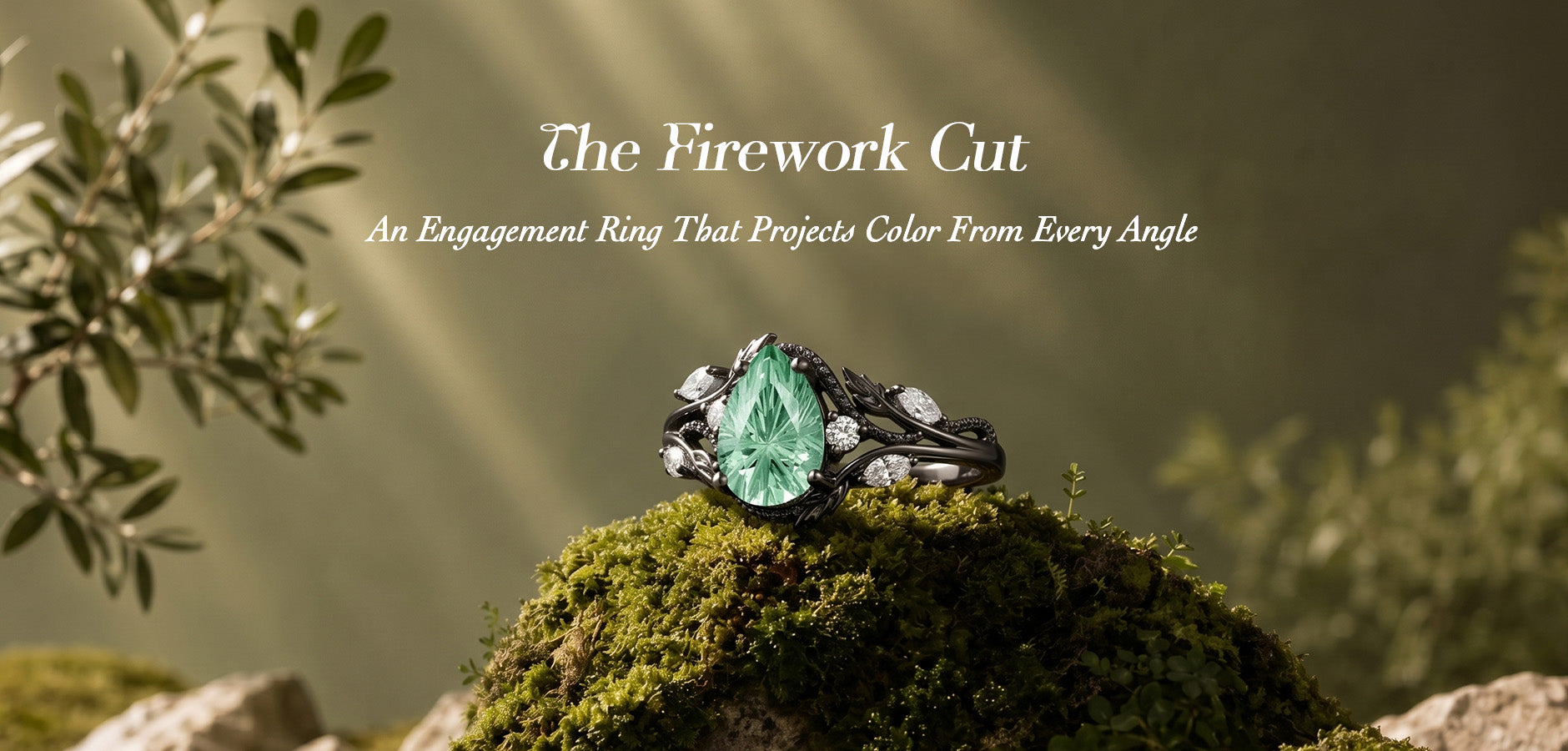
In a Firework Cut, green sapphire does something no other cut achieves: it throws green-tinted light outward. The dispersed flashes carry the stone's verdant hue with them, amplifying the perceived color beyond what the body saturation alone would deliver. In a forest-inspired setting with branch and leaf metalwork, the effect is cohesive — the stone and the setting share a visual language, both referencing the organic world.


Blue Firework Cut — Vivid Cornflower, Wider Reach
Cornflower sapphire is named for the specific blue of the cornflower — a saturated, slightly warm blue that sits between pure blue and violet-blue. It is one of the most sought-after sapphire colors, historically associated with Kashmir stones. Lab-grown cornflower sapphire delivers that exact hue with full traceability and consistent saturation.
In the Firework Cut, cornflower sapphire's vivid blue gets an additional dimension: the dispersed lateral light carries the blue with it, creating a halo effect that makes the stone appear to project its color into the surrounding metal and setting. The ring looks bluer than the stone alone would suggest — the color escapes the stone's borders and becomes ambient.


Other Colors — Ruby & Padparadscha Firework Cut
The Firework Cut extends beyond green and blue into two of the most historically significant gemstone colors: lab ruby and padparadscha sapphire.
Lab Ruby Firework Cut
Ruby has been the red standard for colored engagement rings for centuries. Lab-grown ruby delivers the same chemical composition (chromium-doped corundum), the same hardness (9.0 Mohs), and the same deep red fluorescence as mined ruby — with full traceability.
In the Firework Cut, ruby does something visually unique: the lateral light dispersion carries the stone's deep red saturation outward. Where a standard ruby cut contains the red within the stone's body, the Firework Cut projects it. The ring appears to glow red from multiple angles, not just from the table.
Padparadscha Firework Cut
Padparadscha is the rarest sapphire color — a pinkish-orange to orange-pink hue named for the lotus flower. Historically, natural padparadscha commands prices that exceed fine ruby. Lab-grown padparadscha delivers the same delicate color balance at an accessible price point.
The Firework Cut is perhaps most transformative in padparadscha. The stone's subtle pink-orange hue — already difficult to capture in photographs — becomes ambient. The lateral light dispersion carries the lotus-colored flash outward, making the padparadscha's unique color visible from every angle rather than only from directly above.


How to Choose a Firework Cut Ring
Choose by stone color first. The Firework Cut amplifies whatever color the stone carries. Green sapphire throws green light, cornflower sapphire throws blue, ruby throws red, padparadscha throws pink-orange. The cut does not change the color — it extends its reach. Start with the color that resonates.
Choose by shape second. Marquise Firework Cut stones have two pointed ends and maximum elongation — the shape that makes fingers look longest and most slender. Pear Firework Cut stones have one pointed end and one rounded end — a softer silhouette that still elongates while feeling less angular.
Choose by setting third. BlingFlare's botanical settings — branch, leafy, vine, forest fairy, filigree — are designed to work with the Firework Cut's light behavior. The stone's light behavior and the setting's visual language both reference the natural world. Victorian and ribbon settings offer a more historical frame for the same technology.
Choose by metal last. Yellow gold is the warmest pairing for botanical settings. White gold and platinum maximize contrast with colored stones. Rose gold adds warmth that pairs particularly well with padparadscha and green sapphire. Black gold creates maximum drama — the dark metal makes the Firework Cut's colored light dispersion visually striking.
Related Reads
- Marquise Cut Engagement Rings: The Complete Guide
- Wedding Season 2026: Which Engagement Ring Stone Is Right for You?
- Bridal Sets Collection — Designed to Nest Together
FAQ
What exactly is the Firework Cut?
The Firework Cut is a proprietary modification to standard fancy cuts (marquise and pear) developed by BlingFlare. It alters the pavilion facet angles so that light is dispersed across a wider horizontal angle rather than directed primarily upward through the table. The result: the stone shows visible flash and color from multiple viewing angles — not just from directly above. The name is literal: in side lighting, the stone scatters colored light in a radial pattern that resembles a firework burst.
Which stone color shows the Firework Cut effect most dramatically?
Green sapphire and padparadscha show the most visually distinctive effects. Green sapphire throws green-tinted light outward, which is unusual and immediately noticeable. Padparadscha — with its subtle pink-orange hue — becomes ambient in a way that is difficult to achieve with any other cut. Cornflower sapphire and ruby also show strong lateral color projection, but their saturated body colors are already visible from multiple angles even in standard cuts.
Does the Firework Cut affect the stone's durability?
No. The Firework Cut modifies facet angles, not the stone's structural integrity. The hardness of the stone — 9.0 Mohs for sapphire and ruby — remains unchanged. The cut does not introduce thin points or structural vulnerabilities beyond what the base shape (marquise or pear) already presents. Standard care applies: protective prongs at pointed ends, avoid direct hard impact.
Can you see the Firework Cut effect in photographs?
Partially. Photographs typically capture the stone from a single angle with controlled lighting, which favors the standard upward light return. The Firework Cut's full effect — the lateral flash, the 360-degree visibility, the movement-responsive sparkle — is best experienced in person. Every buyer review of Firework Cut rings at BlingFlare mentions that the stone "does things in person that photos don't show."
What shapes are available in Firework Cut?
Marquise and pear. Both shapes have elongated profiles that provide sufficient surface area for the Firework Cut's modified facet pattern to operate effectively. The marquise delivers maximum finger elongation and a bold, pointed silhouette. The pear offers a softer teardrop profile with one pointed end and one rounded end.
What is BlingFlare's return and warranty policy?
BlingFlare accepts returns within 30 days for quality issues at no cost. Custom modifications and engravings are non-returnable. Each piece comes with a complimentary one-year warranty covering quality issues from craftsmanship. One complimentary resize (±1 size) is available within the first year on most styles. Contact the team at support@blingflare.com with questions about timeline, sizing, or customization.
BlingFlare's Firework Cut collection is available at blingflare.com. The team is available to advise on stone selection, setting options, and metal choices for your specific brief.