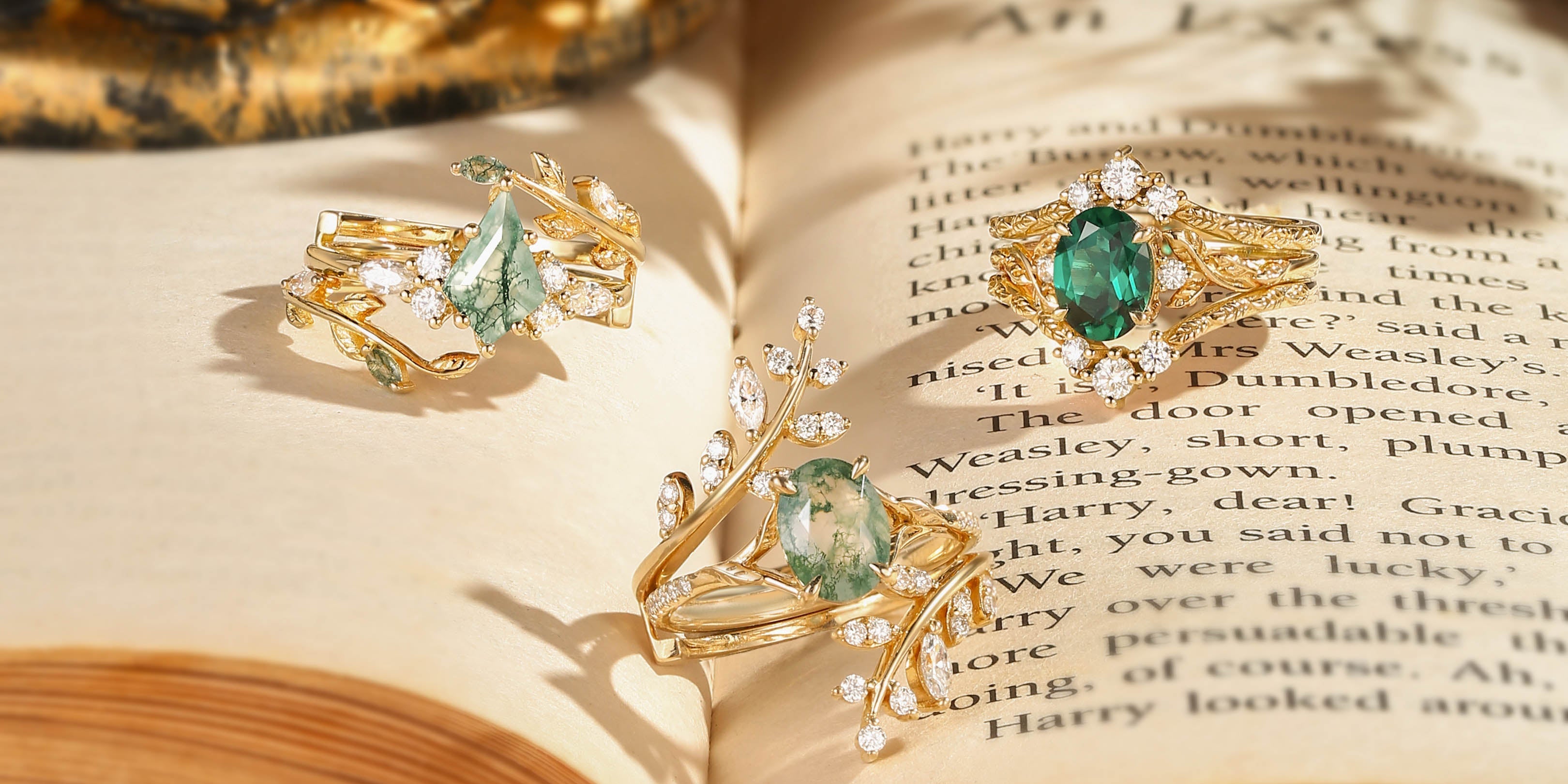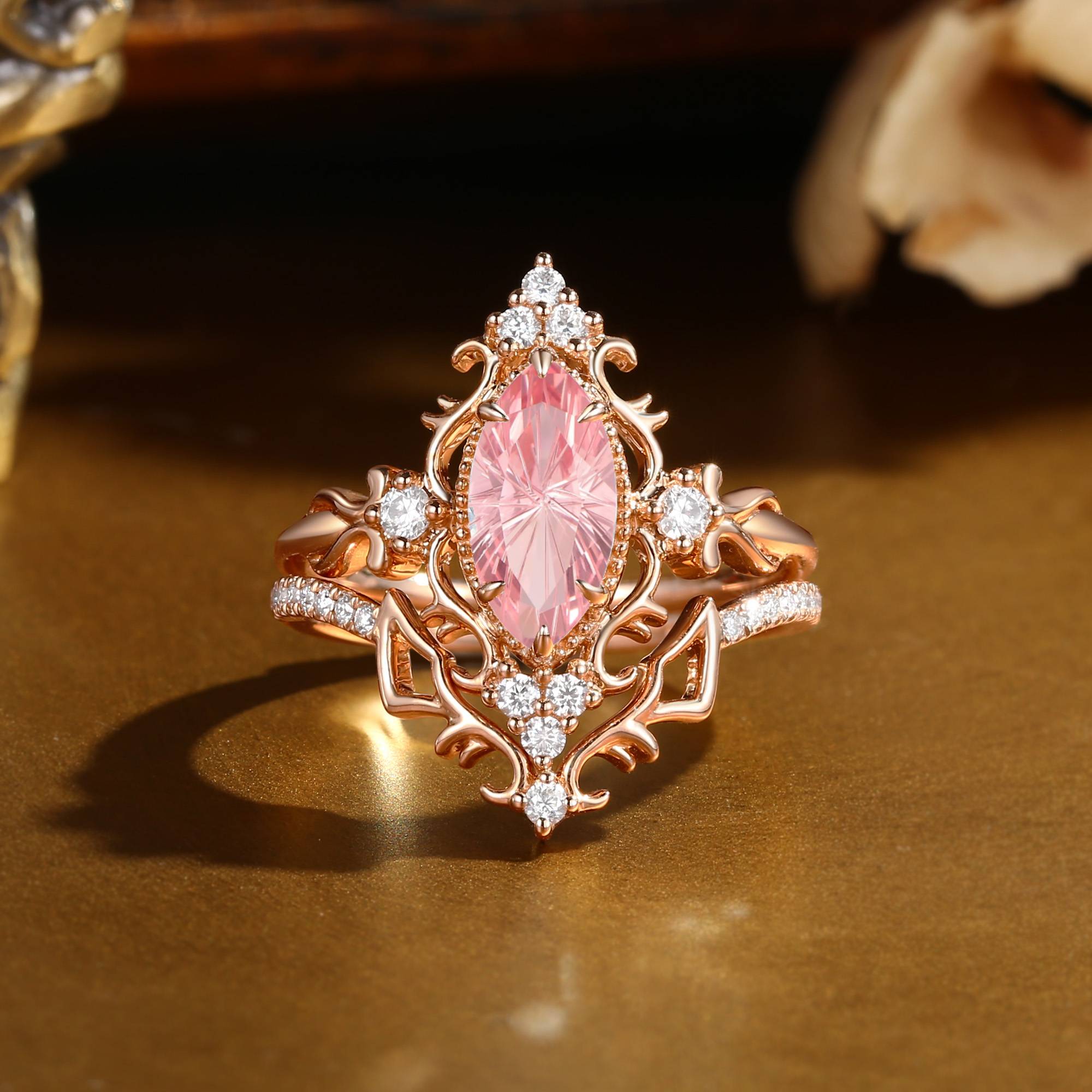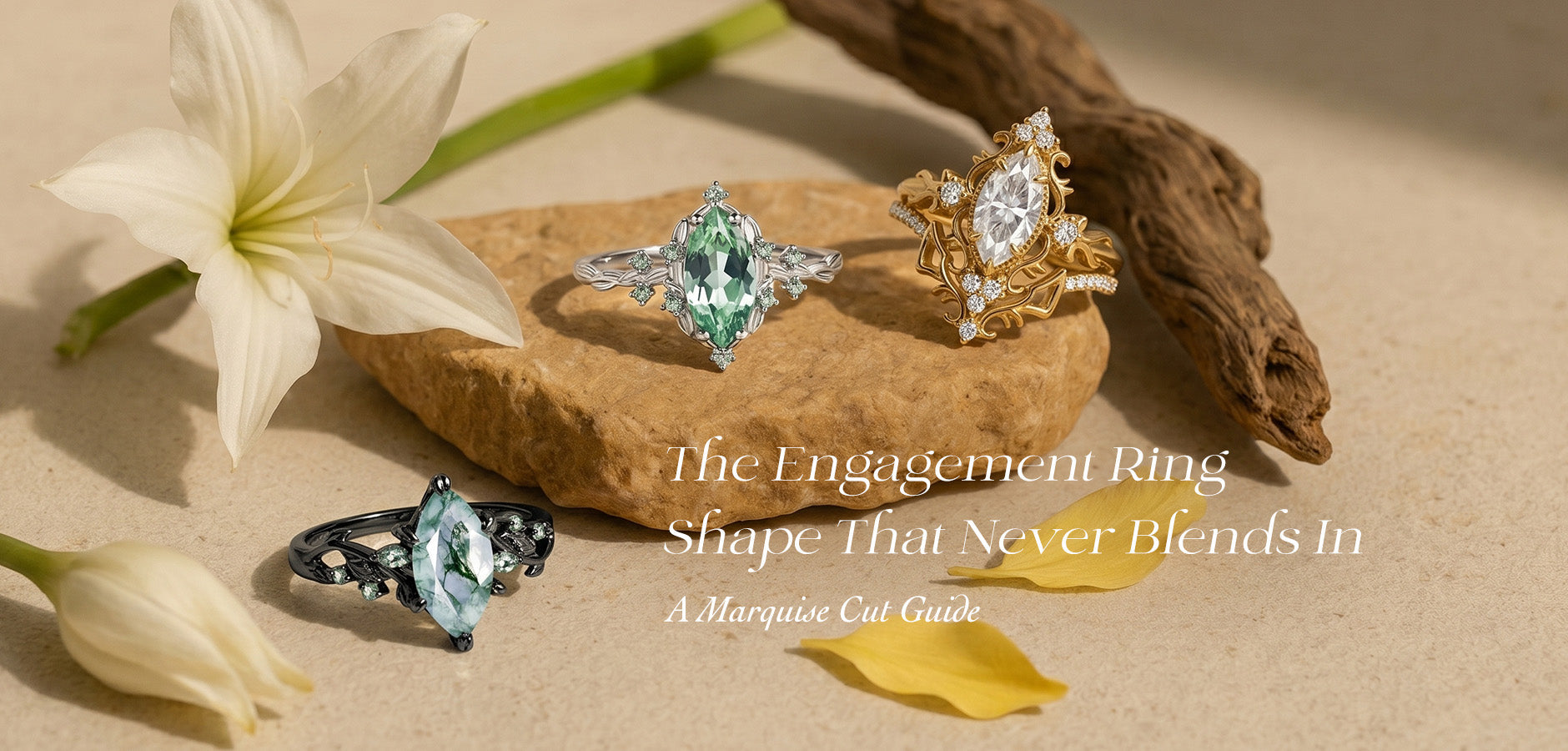
No cut divides opinion like the marquise. Other shapes disappear into familiarity — round brilliants, cushions, ovals. The marquise never does. Its elongated body and two sharp terminal points carry a presence that other cuts spend their entire surface area trying to achieve. It spent several decades being categorized as dated. It is now one of the most-searched ring shapes of 2026, and the reasons are not abstract.
At BlingFlare, the marquise cut collection spans moss agate solitaires, green sapphire bridal sets, moissanite vintage designs, and lab diamond cluster rings — all in solid gold, all made to order. This guide covers the shape, who it is for, and which rings are worth your attention.
Table of Contents
- What Is the Marquise Cut?
- What the Marquise Does to Your Hand
- Marquise vs. Oval vs. Pear: Shape Comparison
- Green Sapphire Marquise Rings — The Forest Bride's Stone
- Moissanite Marquise Rings — Maximum Fire in a Classic Profile
- Other Gemstone Options — Moss Agate, Lab Diamond, Emerald & Ruby
- How to Wear a Marquise: Orientation and Setting
- FAQ
What Is the Marquise Cut?
The marquise is an elongated stone shape with two pointed ends and a curved, symmetrical body between them. It belongs to the fancy cut family — anything outside the round brilliant. Its length-to-width ratio typically falls between 1.75:1 and 2.25:1. At 6×12mm — the standard for a 1ct equivalent — the stone spans roughly the width of two knuckle-joints along the finger.
The name comes from 18th-century France. Louis XV commissioned a stone cut to mirror the shape of the Marquise de Pompadour's lips. Whether the full story is accurate is debated; what is not debated is that the shape emerged from that court era and carries the quality of something intentional and aristocratic from the beginning.
What is technically notable: the marquise's elongated form gives it approximately 10–15% more face-up surface area than a round brilliant of equivalent carat weight. That is geometry, not styling. More face-up surface means more visible presence on the hand with fewer carats. The shape earns its size.
One thing worth knowing before choosing: marquise cuts can produce a "bowtie effect" — a dark shadow across the widest part of the stone, visible from directly above, caused by light returning at angles that do not reach the viewer's eye. In a well-cut marquise, this reduces to a soft shadow that the stone's overall brilliance overwhelms. The cuts in BlingFlare's marquise collection are selected specifically to minimize bowtie while maximizing face-up brightness.
What the Marquise Does to Your Hand
When oriented with its long axis running along the finger — the traditional north-south position — the marquise creates an unbroken visual line from the base of the setting to the tip of the stone. The eye follows that line downward. Fingers appear longer and more slender than any round or square-cut stone achieves at the same carat weight.
This is the same design principle behind pointed-toe shoes and vertical stripes: elongated lines draw perception in one direction and stretch the proportions of whatever surface they are placed on. The marquise applies it to a finger better than any other ring shape. Short fingers benefit most. Wide hands — elongation maximized. Narrower hands — the stone fills and anchors without overwhelming.
The one scenario worth thinking through: very long, very slender fingers, where a smaller marquise stone can feel proportionally small. A 1ct+ center stone at that point resolves it visually.
Marquise vs. Oval vs. Pear: Shape Comparison
| Shape | L:W Ratio | Finger Effect | Visual Size vs. Round | Bowtie? | Trending Orientation |
|---|---|---|---|---|---|
| Marquise | 1.75–2.25:1 | Most elongating | ~10–15% larger | Possible (minimize with quality cut) | N-S and E-W both active |
| Oval | 1.30–1.50:1 | Elongating | ~5–10% larger | Possible | Primarily N-S |
| Pear | 1.45–1.75:1 | Elongating | ~8–12% larger | Possible at shoulders | N-S and E-W both active |
| Round Brilliant | 1:1 | Neutral | Benchmark | None | N/A |
| Cushion | 1:1–1.10:1 | Neutral to widening | Slightly smaller | None | N-S |
The marquise leads on finger elongation, perceived size per carat, and visual distinctiveness. Its trade-off: pointed ends require protective prongs to prevent chipping, and it is less common in the overall market — which is also precisely why it reads as deliberate when you see one.
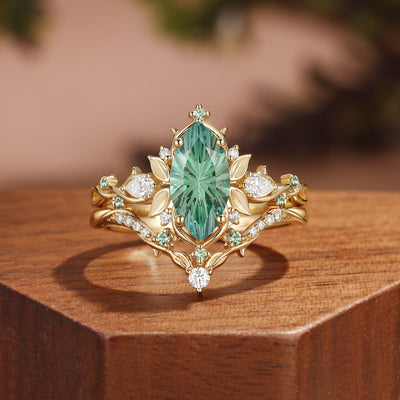
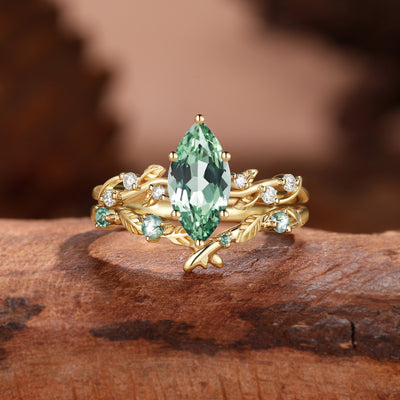
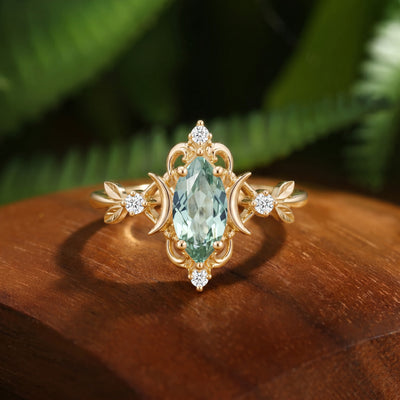
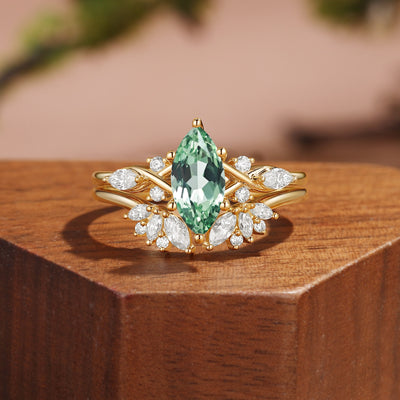
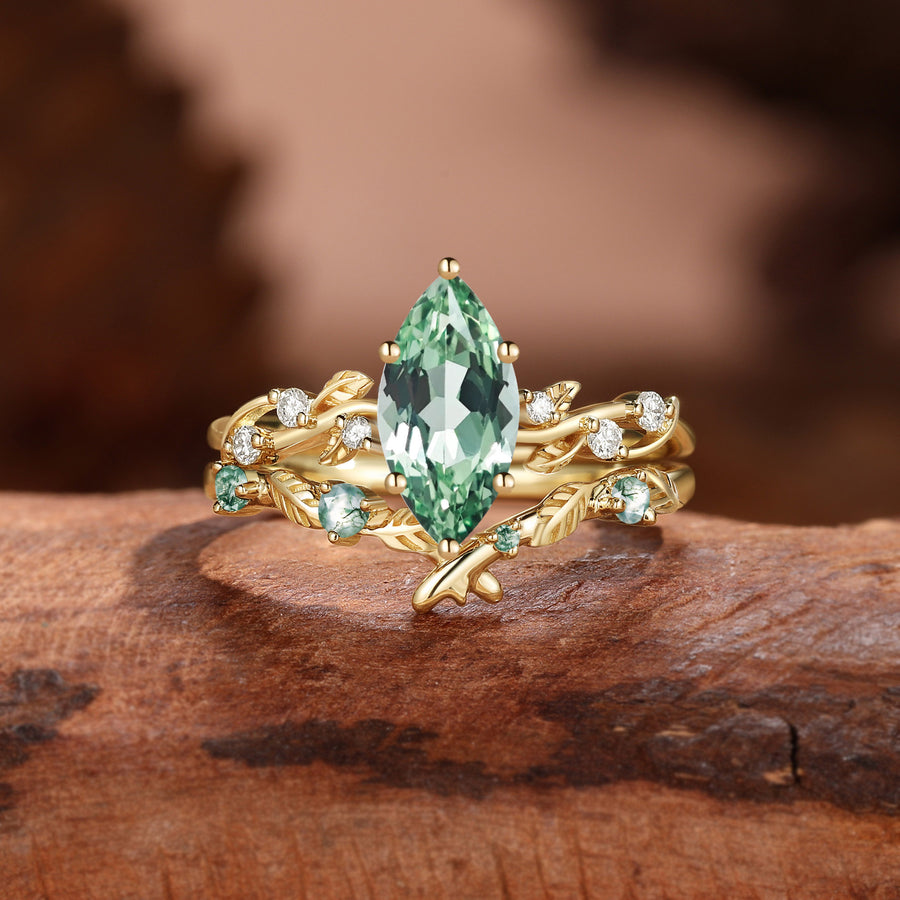
Green Sapphire Marquise Rings — The Forest Bride's Stone
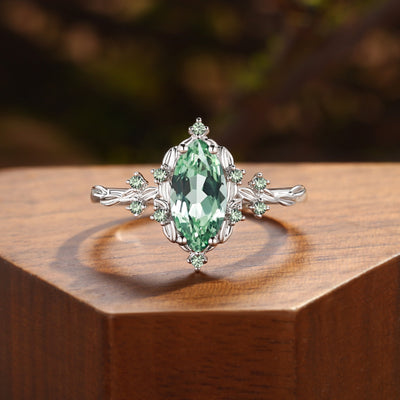
Lab-grown green sapphire scores 9.0 on the Mohs scale — second only to diamond and moissanite. It handles rings worn every day, through all conditions, without special maintenance. Lab-grown means traceable origin, consistent color saturation, and no mining impact.
In a marquise cut, green sapphire reads as inherently botanical. The pointed, leaf-like silhouette of the stone mirrors the same organic shapes that define BlingFlare's nature-inspired settings — vines, leaves, petals, wings. The stone and the setting share a visual language before a single accent stone is added.
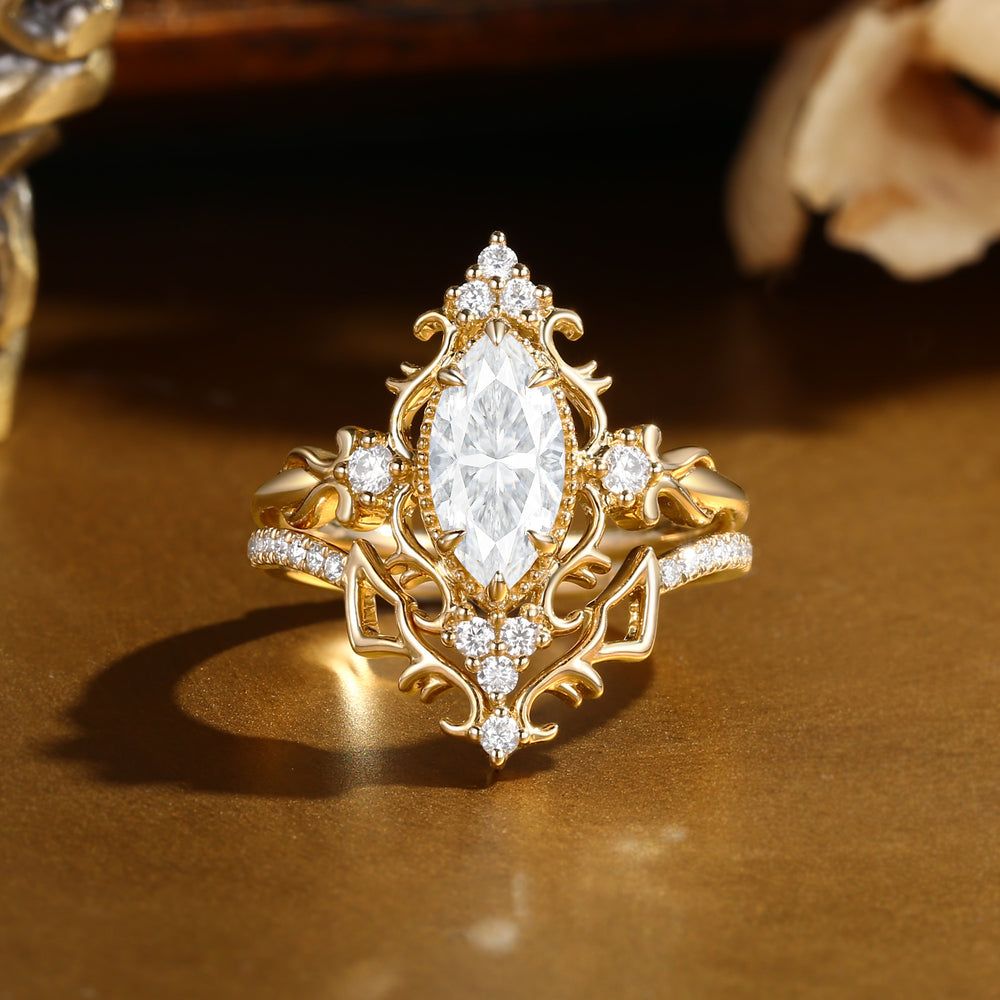
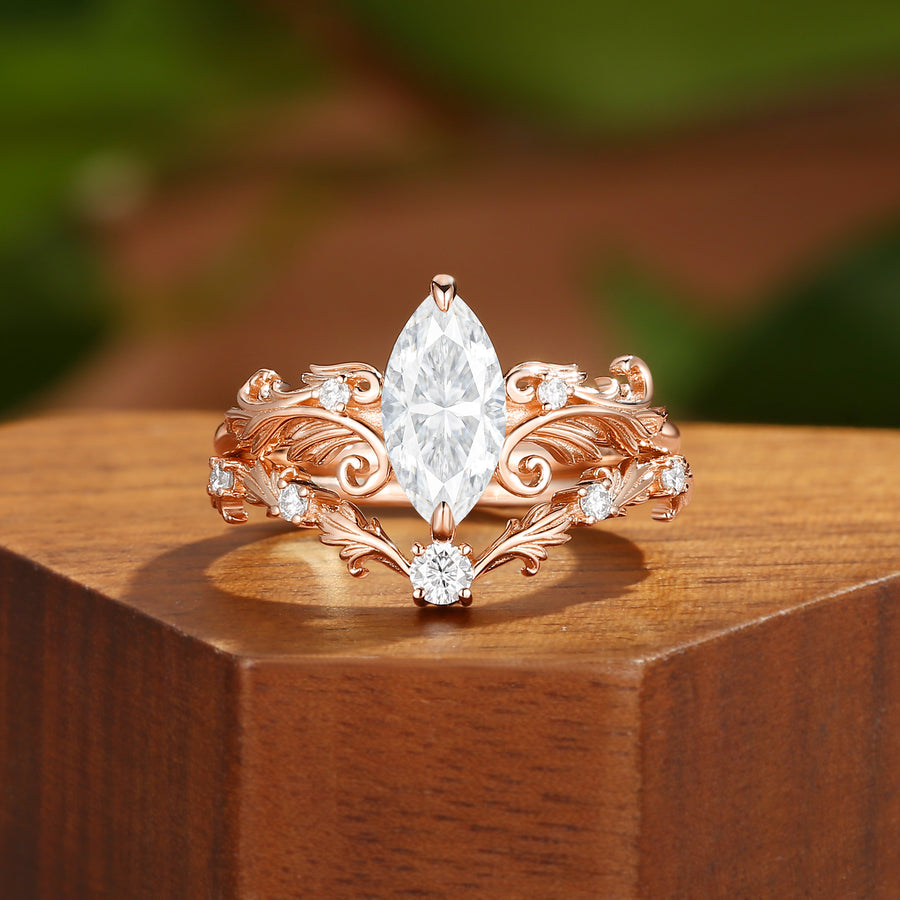
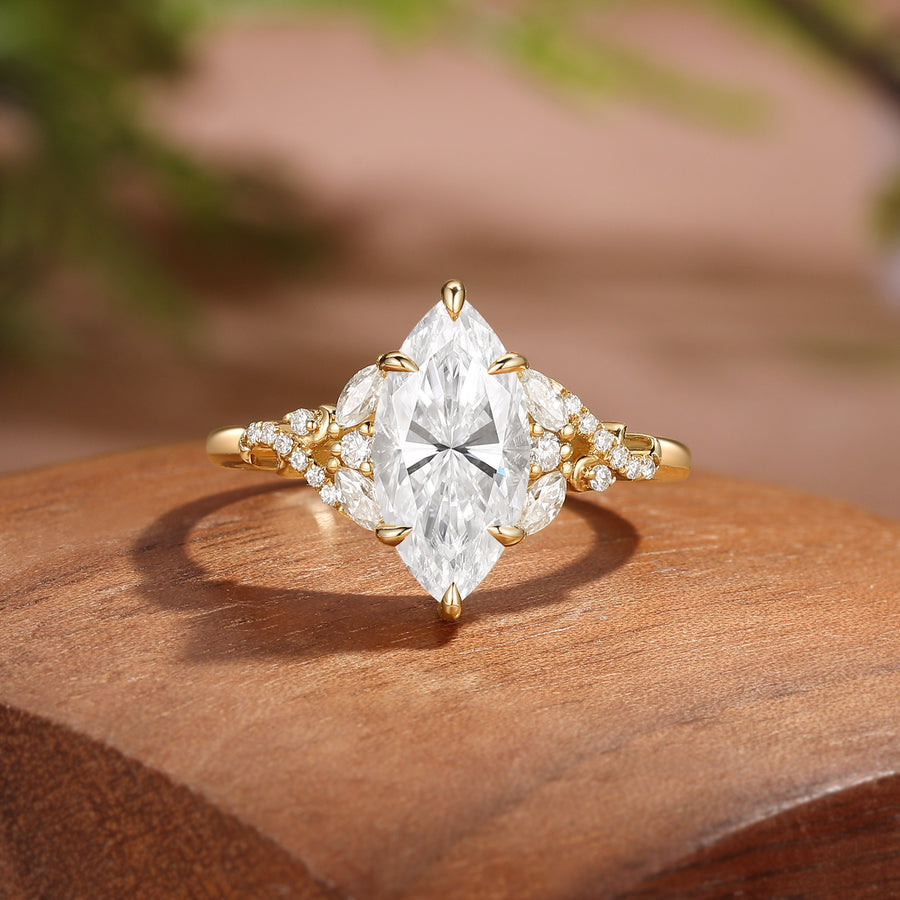
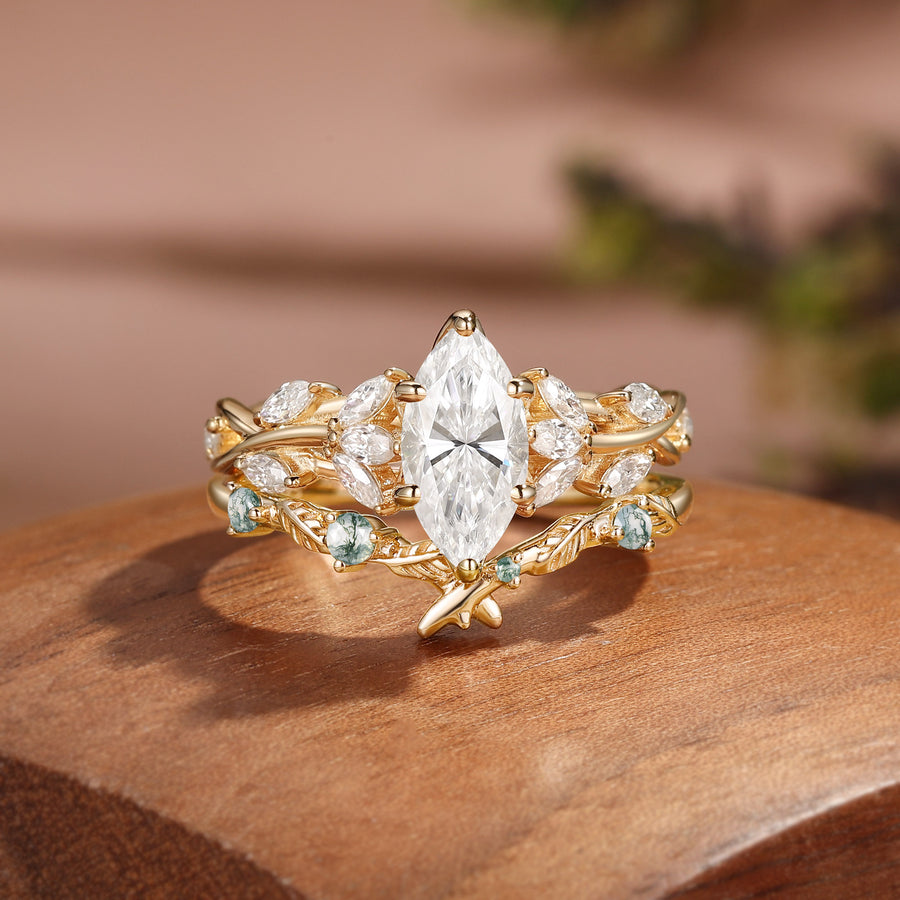
Moissanite Marquise Rings — Maximum Fire in a Classic Profile
Moissanite scores 9.25 on the Mohs scale — the hardest available engagement ring stone outside of diamond. Its refractive index sits at 2.65–2.69, above diamond's 2.42, which means it disperses more colored fire and more white brilliance per square millimeter of surface. In a marquise cut, that fire travels the full 12mm length of the stone. You see it from across a room.
For brides who want a near-colorless white stone in a marquise profile — maximum brilliance, traditional bridal aesthetic, lab-grown ethics — moissanite gives you everything the shape can deliver with no compromise on hardness or optical performance.
Other Gemstone Options — Moss Agate, Lab Diamond, Emerald & Ruby
The marquise collection extends well beyond sapphire and moissanite. For brides who want a one-of-a-kind stone, a classic white diamond, or a vivid colored gemstone with a different character, there are four more categories worth knowing.
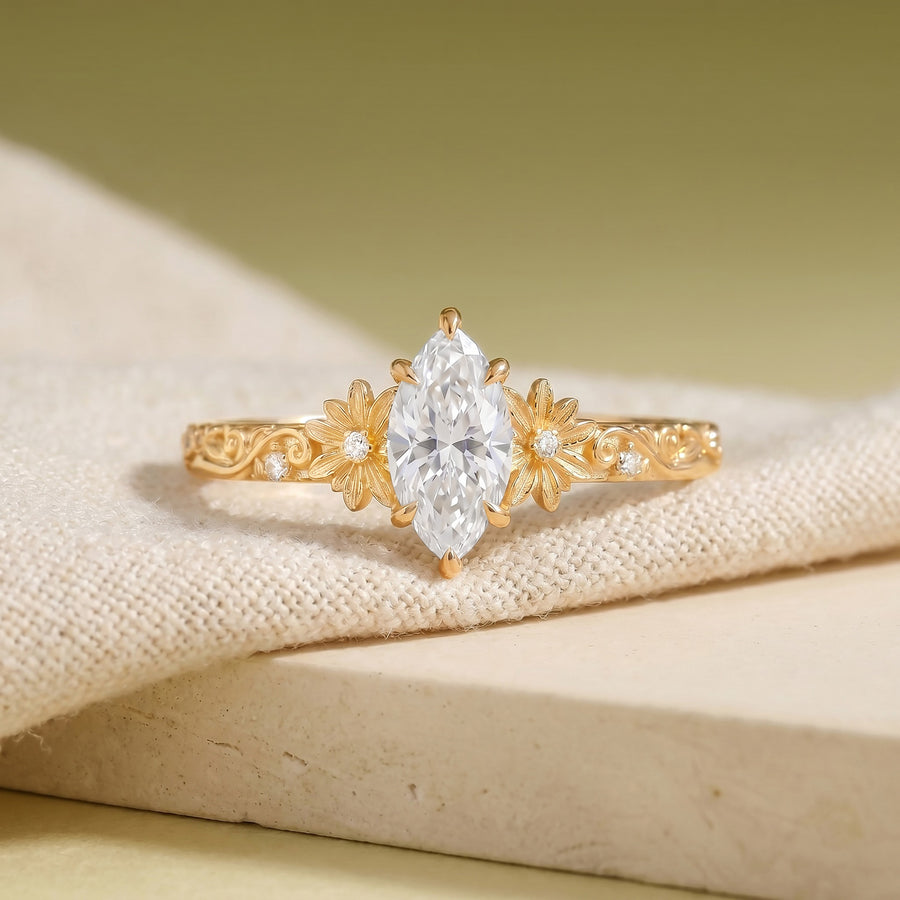
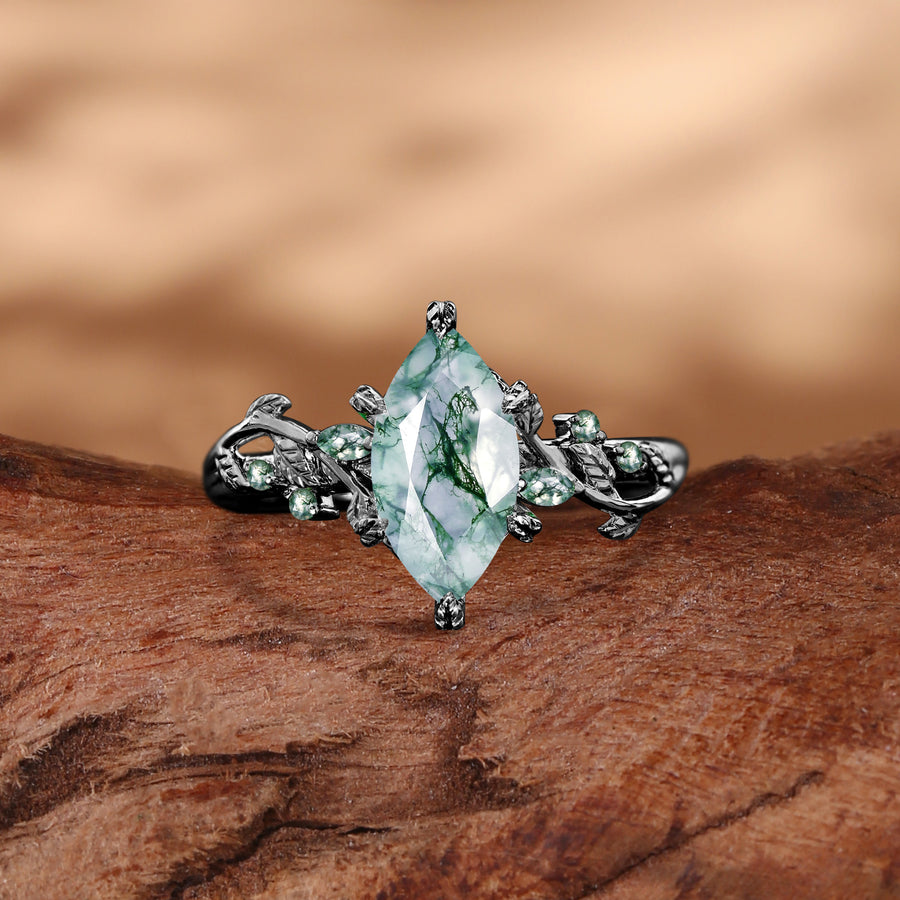
Moss Agate — Florentina
Moss agate is not manufactured to specification. Each stone contains its own pattern of dendrite inclusions — mineral threads that formed over thousands of years inside chalcedony — and no two are identical. In a marquise cut, that pattern runs the full 12mm length of the stone. You are looking through clarity at something that grew in the earth. For brides who want a ring that is genuinely one-of-a-kind, moss agate marquise makes that literal.
Florentina places a 6×12mm marquise moss agate at the center of hand-sculpted rose blooms, unfurling leaves, and a butterfly accent in warm yellow gold. Moissanite accents trail along the band and read as dewdrops caught in morning light. The ring is designed as an environment for the stone, not just a frame for it.
- Center Stone: Moss Agate, 6×12mm, marquise cut
- Accent Stones: Moissanite, D clarity, VS-VVS, 0.26ct total
- Material: 14K or 18K solid gold / platinum
- Price: $1,399
Lab Diamond — Fleur & Elinor
A marquise lab grown diamond is the shape that gives a diamond ring the most vintage character without requiring an antique stone or a reproduction setting. The form does that work for you. Lab-grown puts that at a price point mined equivalents cannot match: same hardness (10 Mohs), same refractive index, same chemical composition — with fully traceable origin.
Fleur features a 1ct marquise lab diamond in a three-stone elf filigree setting — intricate metalwork that looks like it grew from the shank. Elinor is a complete Victorian cluster bridal set with a 1.5ct marquise lab diamond — two pieces engineered to nest flush together, both carrying a consistent heritage metalwork vocabulary.
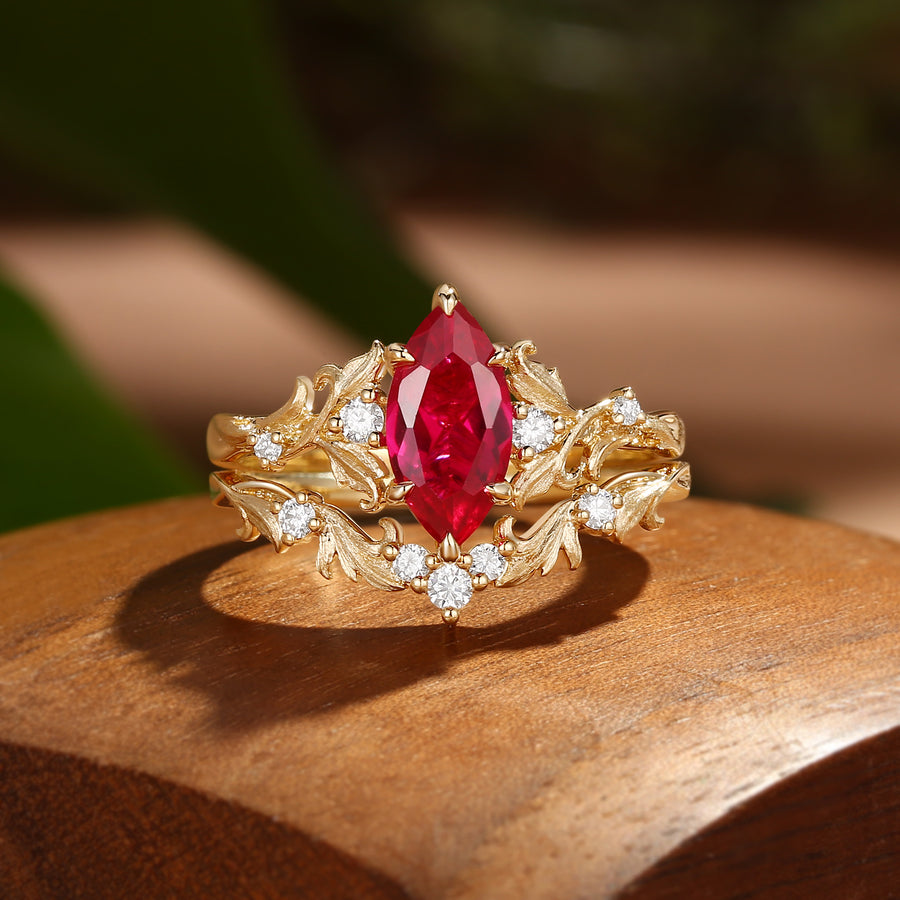
Lab Emerald & Ruby — Lois & Rosa
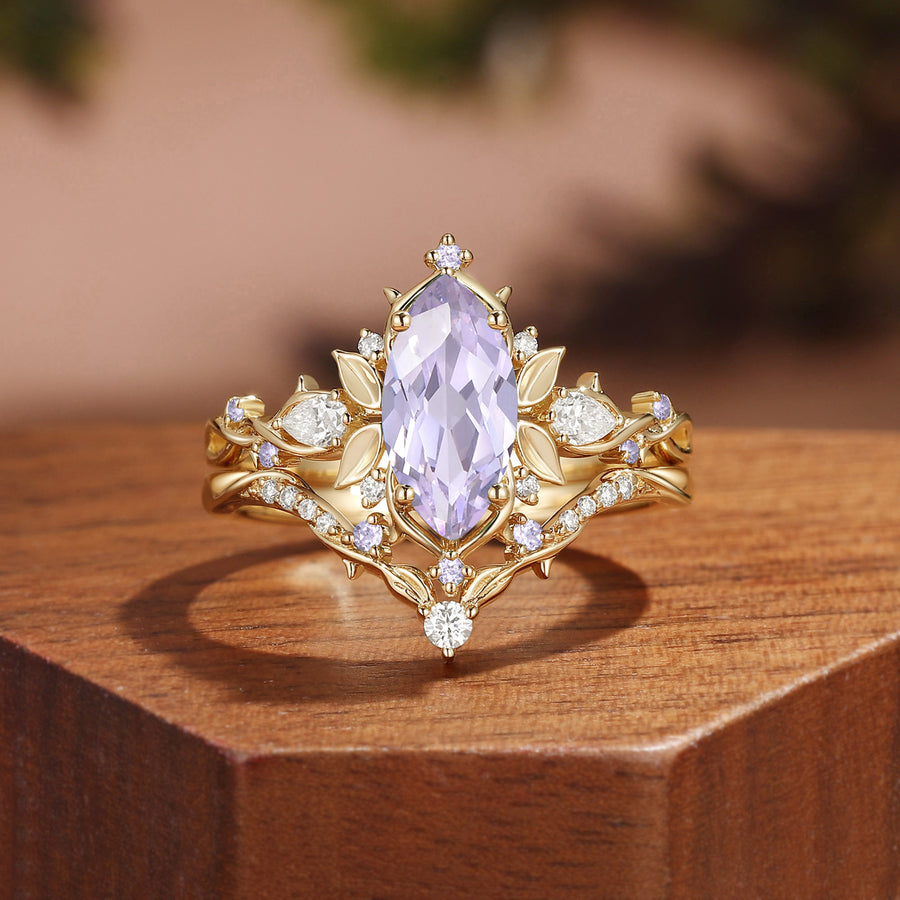
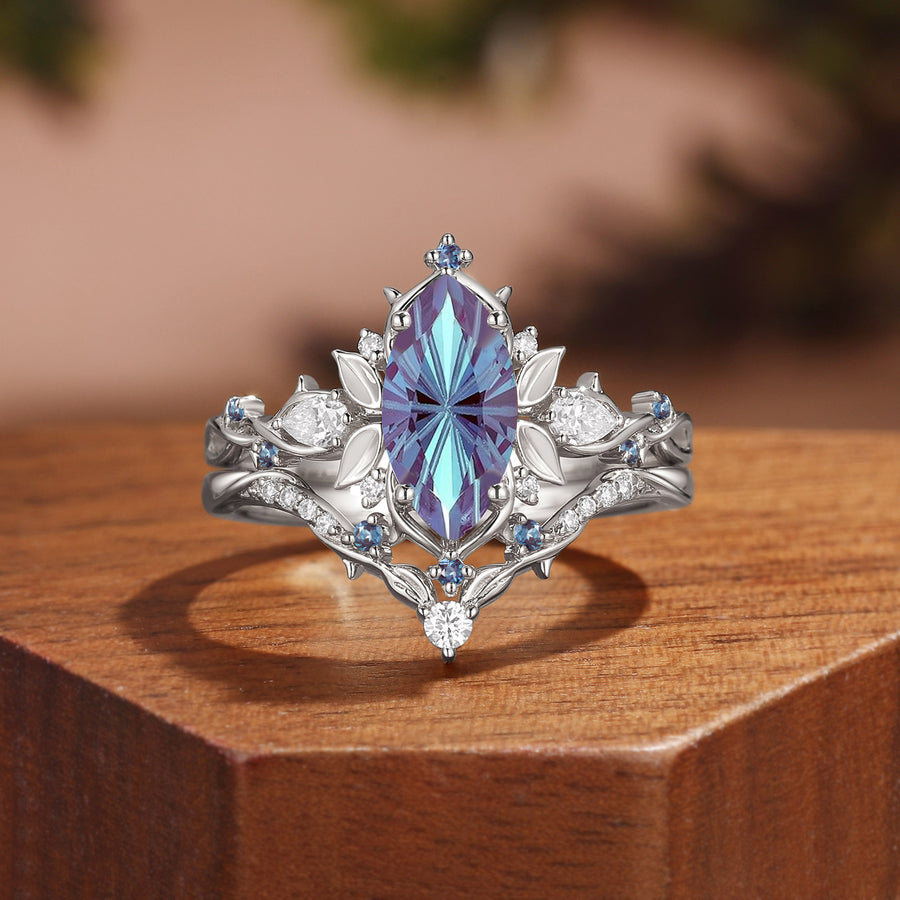
The marquise cut is exceptionally suited to bold colored stones. Its elongated form presents emerald and ruby across maximum face-up surface area, and the pointed silhouette makes vivid color feel intentional rather than aggressive.
Lois places a marquise lab emerald at the center of a Royalcore filigree setting — intricate wirework drawing from Victorian and Edwardian ornamental traditions. For the bride who wants vivid green with maximum historical gravitas. Rosa is a marquise lab ruby in an acanthus leaf Art Deco bridal set — structured, ornamental, and completely deliberate as an aesthetic statement.
How to Wear a Marquise: Orientation and Setting
North-South (Traditional) — The pointed ends run along the finger's length. This is the orientation that delivers everything the marquise promises: maximum elongation, maximum face-up presence, the clearest expression of the shape's form. Correct for most hand types.
East-West (Contemporary) — The pointed ends run horizontally across the finger. Trending heavily in 2026. The elongating property is exchanged for something graphic and deliberately unconventional — a ring that signals an aesthetic position rather than follows one. East-west marquise rings read as fashion-forward in a way that very little else in bridal jewelry currently does.
Prong Placement — The marquise's pointed ends are its most structurally vulnerable points. Prongs or bezel elements at both tips are required to prevent chipping from direct impact. Six-prong settings (four side prongs plus two tip prongs) provide the most secure coverage while keeping the stone visible. Bezel settings offer maximum protection with a modern profile. All BlingFlare marquise settings include tip protection as standard.
Solitaire vs. Cluster vs. Three Stone — Solitaire settings let the marquise shape dominate entirely: clean, intentional, maximalist in form. Cluster settings, like Florentina's floral design, add visual complexity at the band level without interrupting the stone's profile from above. Three-stone settings reinforce the elongated language of the center stone when all three pieces echo the marquise or pear silhouette.
Metal Choice — Yellow gold is the historically correct pairing; the marquise originated in 18th-century French gold jewelry. White gold and platinum clean up the silhouette and maximize visual contrast with both colorless and colored stones. Rose gold adds warmth and pairs particularly well with moss agate and pink sapphire. All four metals are available throughout BlingFlare's marquise collection.
Related Reads
- Wedding Season 2026: Which Engagement Ring Stone Is Right for You?
- Bridal Sets Collection — Designed to Nest Together
FAQ
Is the marquise cut back in style for 2026?
Yes — and the return is real. Search data for "marquise engagement ring" has climbed consistently since 2022. The resurgence is partly driven by high-profile engagements featuring marquise stones, partly by the broader shift toward fancy cuts among younger buyers who want something less common than a round brilliant. For 2026, marquise is one of the top five fancy shapes actively being requested. The east-west orientation trend has introduced it to an entirely new audience.
Does the marquise cut actually make fingers look longer?
Yes, reliably — when oriented north-south. The elongated vertical axis creates a single continuous line along the finger that draws the eye downward and visually stretches the proportions of the hand. Among all engagement ring shapes, the marquise produces the most pronounced elongating effect. Short fingers benefit most. Very long slender fingers see the least visible difference — at that hand type, stone proportions matter more than orientation.
Can I wear a marquise ring east-west (horizontal)?
Yes, and it is a legitimate and increasingly popular choice. East-west orients the pointed ends side-to-side across the finger rather than along it. The finger-elongating effect is lost, but the result is a graphic, bold silhouette that reads as deliberately unconventional. Several BlingFlare marquise solitaire settings work well in either orientation — contact the team before ordering to confirm which settings are best suited to east-west.
Is a marquise cut good for colored gemstones?
Exceptionally well-suited. The elongated form shows color across a wide face-up surface area, and the pointed silhouette echoes organic shapes — leaves, petals, wings — that make marquise a natural fit for nature-inspired botanical settings. Moss agate, green sapphire, alexandrite, lab emerald, ruby, amethyst, and aquamarine all translate beautifully to the marquise cut. The shape makes colored stones feel more deliberate and distinctive than a round cut of the same stone would.
How durable is a marquise ring for daily wear?
As durable as the stone material itself — the marquise cut does not compromise the stone's hardness. The specific structural consideration is the pointed ends, which are the thinnest parts of the stone and most susceptible to chipping from direct hard impact. This is addressed in setting design: prong or bezel coverage at both tips protects these points in every BlingFlare marquise setting. With proper setting, a marquise ring handles daily wear without special precautions.
What is BlingFlare's return and warranty policy?
BlingFlare accepts returns within 30 days for quality issues at no cost. Custom modifications and engravings are non-returnable. Each piece comes with a complimentary one-year warranty covering quality issues from craftsmanship. One complimentary resize (±1 size) is available within the first year on most styles. Contact the team before ordering if you have questions about timeline, sizing, or customization options.
BlingFlare's full marquise cut collection is at blingflare.com/collections/marquise-cut. The team is available to advise on stone selection, setting options, and metal choices for your specific brief.