Some rings sparkle. A rare few seem to live. Alexandrite engagement rings belong to the second category — a green-to-purple color-changing gemstone that shifts its appearance with every light source, every hour of the day, every angle of your hand. It is the only engagement ring stone that genuinely looks different on your wedding day than it does on your tenth anniversary, and that is precisely why couples who choose it never get tired of looking at it.
At BlingFlare, we set lab-created alexandrite in cool white gold, frame it with deep black moissanite accents, and wrap it in leaf, moon, and Celtic-knot details — because a stone this alive deserves a setting with a soul. If you have been searching for unique gemstone rings that no one else at the brunch table will be wearing, you have just found your stone.
This guide covers everything you need to know before buying an alexandrite engagement ring: why the stone changes color, what it symbolizes, why white gold is its ideal partner, and three BlingFlare designs that show the gem at its most dramatic.
Table of Contents
- What Makes Alexandrite So Extraordinary?
- The Symbolism: Transformation, Balance, New Chapters
- Why White Gold Is the Perfect Setting for Alexandrite
- Black Moissanite Accents: The Dark Romantic Contrast
- Design Styles That Shine With Alexandrite
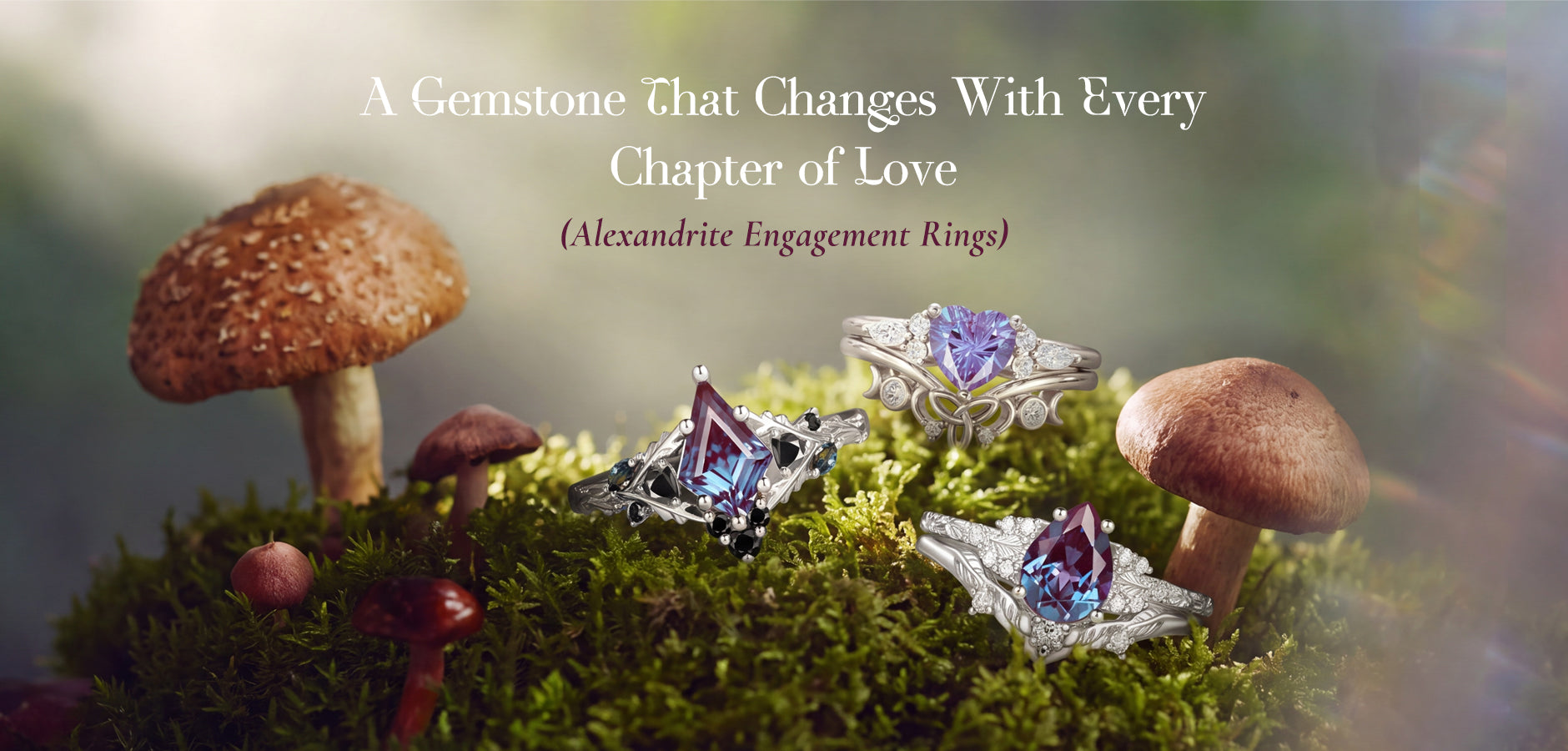
- Three BlingFlare Alexandrite Designs We Love
- FAQ
What Makes Alexandrite So Extraordinary?
Alexandrite is famous for one trick no other popular engagement ring stone can match: a dramatic color change. The classic description — "emerald by day, ruby by night" — is not marketing poetry. In daylight or cool LED light, a fine alexandrite reads green to teal. Under warm incandescent or candlelight, the same stone shifts toward raspberry, plum, or deep purple-red.
The science behind the magic: alexandrite is a variety of the mineral chrysoberyl, and trace amounts of chromium are believed to be responsible for the way it absorbs light differently across the spectrum. Daylight is rich in blue and green wavelengths, which the stone reflects back as green. Incandescent light is rich in red and yellow wavelengths, which pull the stone toward red and purple. Same ring, two personalities.
A few facts that add to the romance:
- Hard enough for forever. Alexandrite ranks 8.5 on the Mohs scale of hardness — tougher than emerald, close to sapphire — making alexandrite wedding rings a genuinely practical choice for everyday wear.
- A stone with a name. Alexandrite was first discovered in the Ural Mountains of Russia in the 1830s and was named after the future Czar Alexander II. Its green-and-red colors happened to match Imperial Russia's military colors, which made it an instant aristocratic favorite.
- The June birthstone. Alexandrite shares the June birthstone honor with pearl and moonstone, which makes it a quietly meaningful choice for June brides — or for anyone born in the month.
- Genuinely rare in nature. Natural alexandrite with strong color change is one of the rarest gemstones on Earth. That rarity is exactly why BlingFlare works with lab-created alexandrite — the same chrysoberyl chemistry and the same captivating color shift, without the scarcity markup or the mining footprint.
The Symbolism: Transformation, Balance, New Chapters
Gemstones have carried meaning for centuries, and alexandrite's is unusually honest about what love actually is.
Transformation. Alexandrite does not hide its changes — it performs them. For a couple, that is a powerful emblem: love is not a fixed state but a continuous becoming. The stone you wear on the day you say "I do" will look different under the lights of your first apartment, your wedding reception, your anniversary dinner — and it will still be the same stone, the same promise. Growing together is not a threat to a relationship. It is the whole point.
Balance. The color change of alexandrite lives in the balance between two kinds of light — the cool clarity of day and the warm intimacy of evening. There is a lesson in that about partnership itself: understanding and companionship are not about one person dominating the light, but about two people learning how to share it.
New Chapters. Every shift of color marks a new moment. Alexandrite has become a favorite among couples who see engagement not as an ending of courtship but as the opening line of a longer story — a stone for people who are excited, not anxious, about what comes next.
The first time I wore my alexandrite ring to dinner, I gasped mid-conversation — the stone had gone from sea-green to deep violet under the restaurant lights. My husband laughed and said, "It changes its mind, just like you." Now we call it the mood ring. Twelve years married, and it still surprises me.
— Danielle M., BlingFlare customer
Why White Gold Is the Perfect Setting for Alexandrite
A color-changing stone is demanding company for a metal — the wrong setting can flatten its shifts or tint its greens muddy. This is why a white gold alexandrite ring is the connoisseur's choice, and why BlingFlare recommends it.
Cool metal, clearer color change. White gold's neutral, silvery tone acts like a clean gallery wall. It reflects light back through the stone without adding warmth of its own, so the green-to-purple transition stays crisp. Yellow gold, by contrast, can pull the stone's daytime color toward olive; rose gold can muddy the reds. White gold simply lets the alexandrite be itself.
Minimal, premium, modern. White gold reads as quiet luxury — refined rather than loud. For a stone already doing something extraordinary, that restraint matters. The metal steps back; the color change takes the stage. The result is a modern, sophisticated alexandrite wedding ring that looks intentional rather than decorative.
A spotlight, not a costume. Because white gold is visually calm, the center stone becomes the undeniable focal point. In BlingFlare's designs, cool white metal also pairs beautifully with dark accent stones, creating a monochrome frame around the shifting color at the center — more on that below.
Black Moissanite Accents: The Dark Romantic Contrast
If white gold is the clean canvas, black moissanite is the shadow that gives the painting depth. A black moissanite engagement ring design — dark accents flanking a color-changing center stone — is one of the most striking directions in unique gemstone rings right now, and alexandrite is the ideal stone to build it around.
Contrast that amplifies the change. Black is the absence of competing color, which means nothing distracts from the alexandrite's shift. Set a green-to-plum alexandrite beside glossy black stones, and both phases of the color change read more saturated, more intentional, more alive.
Mystery and layering. Dark accents give the design a sense of depth — light and shadow, day and night, mirrored in one ring. It is jewelry with a gothic-novel undertone: romantic, a little mysterious, and impossible to categorize.
The Dark Romantic / Modern Fantasy aesthetic. Black moissanite paired with a color-shifting center stone and botanical metalwork defines what designers are calling Dark Romantic style — think moonlit gardens, old libraries, fairy tales with strong heroines. It is fantasy without costume, vintage without dust.
Design Styles That Shine With Alexandrite
Alexandrite's chameleon nature makes it unusually versatile across design languages. Four directions work especially well:
Vintage-inspired. The stone's 19th-century Russian origins pair naturally with heirloom detailing — milgrain edges, filigree openwork, and antique silhouettes. If old-world romance is your register, explore BlingFlare's retro filigree designs and Royalcore vintage collection as starting points.
Dark romantic. Black accents, oxidized textures, moon and knot motifs — the aesthetic of candlelight and secrets. Alexandrite's evening-red phase was practically made for this mood.
Fairy / fantasy. Crescent moons, Celtic knots, firework-cut stones that scatter light like sparks. Alexandrite's color shift gives fantasy designs their "is it enchanted?" quality — browse BlingFlare's fairy rings for the full effect.
Nature-inspired. Leaves, vines, and botanical metalwork frame the stone as something discovered in a forest rather than bought in a mall. The leaf ring collection is BlingFlare's signature territory — and a natural home for a June birthstone engagement ring.
Three BlingFlare Alexandrite Designs We Love
Every BlingFlare alexandrite ring is made to order in 14K or 18K solid gold (yellow, white, rose, or black) or 950 platinum, with lab-created alexandrite at the center. Below, three designs shown in white gold — our recommended setting for maximum color-change drama.
Katriel — Kite Cut Lab Alexandrite & Black Moissanite Oak Leaf Ring
Unleash your wild side. Katriel sets a kite-cut lab alexandrite — 6x9mm, with the deep purple-dark tone the stone is loved for — into an oak leaf design, flanked by mysterious black moissanites and green sapphires. The oak leaf is not just pretty: it is a nod to lasting love that grows stronger with time, which makes it a quiet match for a stone that symbolizes transformation.
Specifications:
- Center stone: Lab alexandrite, 6x9mm, kite cut (June birthstone)
- Accent stones: Black moissanites and green sapphires, D clarity, VS-VVS color, 0.35ct total
- Band: 1.6mm, delicate yet durable
- Metals: 14K/18K solid gold or 950 platinum (shown in white gold)
- Price: from $1,359 (14K white gold) to $2,259 (950 platinum)
Hortense — Pear Cut Lab Alexandrite Leaf Bridal Set (2 Pieces)
Hortense is the full story in one box: a pear-cut lab alexandrite engagement ring and its matching leaf-inspired wedding band, designed to be worn together. The 6x8mm pear center catches light from a long, elegant angle, while moissanite accents (0.5ct total) give the set serious fire. As a bridal set, it is the most complete answer to the alexandrite wedding rings question — the proposal ring and the forever band, already in harmony.
Specifications:
- Center stone: Lab alexandrite, 6x8mm, pear cut
- Accent stones: Moissanites, D clarity, VS-VVS color, 0.5ct total
- Band: 1.6mm, delicate yet durable
- Metals: 14K/18K solid gold or 950 platinum (shown in white gold)
- Price: from $1,889 (14K white gold) to $3,189 (950 platinum)
Briar — Firework Cut Heart Alexandrite Celtic Knot & Moon Ring Set
Briar is for the bride who wants symbolism in every millimeter. Its firework-cut heart alexandrite — a BlingFlare signature cut that throws color from every facet — is paired with Celtic knot and moon motifs that evoke vintage charm and old-world mystery. The official word on it says it best: a set that "blends classic craftsmanship with mystical allure, perfect for those who appreciate meaningful, heirloom-inspired jewelry."
Specifications:
- Center stone: Firework cut lab alexandrite, 6mm, heart shape
- Accent stones: Moissanites, D clarity, VS-VVS color, 0.25ct total
- Band: 1.6mm, delicate yet durable
- Metals: 14K/18K solid gold or 950 platinum (shown in white gold)
- Price: from $1,999 (14K white gold) to $3,499 (950 platinum)


Design Your Own with BlingFlare
Alexandrite is a stone about becoming — so it feels right that your ring can become something entirely yours. At BlingFlare, our nature-inspired engagement ring collection is the starting point, not the finish line: an alexandrite center stone in white gold, black moissanite accents, leaf or botanical details, moon motifs — mixed and matched around your story. If you are imagining a combination we have not made yet, reach out to our team. We would love to hear what your ring should mean.
Related Reads
- The Ultimate Guide to Birthstones: Meaning, History & How to Choose Yours — Alexandrite is June's color-changing birthstone
- What Is the Firework Cut? The Engagement Ring Cut That Throws Color From Every Angle — the story behind Briar's signature cut
- The Symbolism Behind Fairy Ring Designs: What Each Element Means — leaves, moons, and knots decoded
FAQ
Are alexandrite engagement rings durable enough for everyday wear?
Yes. Alexandrite ranks 8.5 on the Mohs hardness scale — harder than emerald and only slightly softer than sapphire — and it has no cleavage planes that make it prone to splitting. With normal care, alexandrite wedding rings hold up beautifully to daily life.
What does alexandrite look like in different lighting?
In daylight and cool white light, alexandrite appears green to teal. Under warm incandescent or candlelight, it shifts toward raspberry, plum, or purple-red. BlingFlare's lab alexandrite leans toward the deep purple-dark tones the stone is prized for, with visible change between light sources.
Is lab-created alexandrite real alexandrite?
Yes — lab-created alexandrite is chrysoberyl with the same chemistry, crystal structure, hardness, and color-change behavior as mined alexandrite. It is grown above ground rather than mined, which makes it more accessible and traceable. Every BlingFlare alexandrite ring uses lab-created stones.
Why choose lab-grown alexandrite instead of natural?
Natural alexandrite with strong color change is extraordinarily rare and priced accordingly. Lab-created alexandrite delivers the same optical magic at a realistic price point, with consistent quality and no mining impact — the practical path to a genuine color-change ring.
What metal looks best with alexandrite?
White gold is our top recommendation: its cool tone keeps the green-to-purple color change crisp and lets the stone stay the focal point. Yellow gold warms the daytime color, and black gold deepens the dark-romantic mood. BlingFlare offers 14K/18K gold in four colors plus 950 platinum.
How do I care for an alexandrite ring?
Clean with warm water, mild soap, and a soft brush; avoid harsh chemicals and ultrasonic cleaners with questionable settings. Store separately from harder stones to prevent scratches, and have the prongs checked annually — standard good habits for any fine engagement ring.