An engagement ring is already one of the most meaningful pieces of jewelry you'll ever wear. But what if it carried a detail so personal, so quietly intimate, that only you and your partner knew it was there? That's the idea behind hidden birthstone rings — a growing trend in personalized engagement rings that transforms a beautiful piece of jewelry into a private love letter. A small gemstone, tucked beneath the center stone, engraved inside the band, or woven into a leaf or vine detail, carries a meaning no one else needs to see. It's your secret. And that's precisely what makes it extraordinary.
At BlingFlare, nature-inspired designs — leaf settings, crescent moon details, botanical vine work — already tell stories about growth, eternity, and organic beauty. Adding a hidden birthstone takes that storytelling to another level. Whether you're drawn to the idea of your partner's birth month, a month that marks a milestone in your relationship, or the timeless tradition of "something blue," this guide covers everything you need to know about choosing and designing a hidden birthstone engagement ring.
Table of Contents
- Why Couples Are Choosing Hidden Birthstone Rings
- The Symbolism Behind Hidden Birthstones
- Complete Birthstone Chart: All 12 Months
- Something Blue: The Wedding Tradition Built Into Your Ring
- Where Is the Birthstone Hidden? Design Options
- Which Gemstones Work Best for Everyday Wear?
- Nature-Inspired Designs Perfect for Hidden Birthstones
- Design Your Own with BlingFlare
- FAQ
Why Couples Are Choosing Hidden Birthstone Rings
The shift toward custom engagement rings isn't just about choosing a non-traditional stone or an unusual setting. It's about embedding meaning into every detail of the design. Couples today want rings that don't just look beautiful — they want rings that mean something. A hidden birthstone does exactly that.
It's personal. A birthstone connects the ring to a specific person, a specific date, a specific story. It's not a generic symbol — it's yours.
It's private. The beauty of a hidden birthstone is that it doesn't announce itself. The ring can look classic, elegant, minimalist from the outside. But close up, or turned inward, there's a detail that belongs only to the two of you. That intimacy is something no visible design element can replicate.
It's romantic. Think of it as a secret between partners. Every time you glance at the ring and remember the tiny sapphire under the center stone — your partner's September birthmonth — it's a small, private smile.
It's a trend with staying power. Personalized jewelry has been growing for years, but hidden birthstone designs are accelerating. Social media, celebrity engagement reveals, and the broader "quiet luxury" movement all point toward the same thing: meaningful details over obvious statements. A hidden birthstone is the ultimate quiet luxury in jewelry.
We wanted our ring to look timeless from the outside, but when I turn mine, there's a tiny green sapphire — his birthstone — set into the inner band. It's our little secret, and I love that no one else knows it's there.
— Emily R., BlingFlare customer
The Symbolism Behind Hidden Birthstones
Partner's Birthstone: A Connection Only You Two Share
Choosing your partner's birth month gemstone is the most common — and most romantic — approach. It represents a bond that's as unique as the two of you. The stone isn't just decorative; it's a symbol of the person you chose, the month that brought them into the world, the qualities that gemstone has carried for centuries.
A July partner gets a ruby — the stone of passion. A December partner gets turquoise or tanzanite — the stone of good fortune. A June partner gets alexandrite — the stone of change and growth. Each one carries generations of meaning, and when it's hidden inside your ring, that meaning becomes a private conversation between you and your partner.
Complete Birthstone Chart: All 12 Months
| Month | Birthstone | Symbolism |
|---|---|---|
| January | Garnet | Trust & protection |
| February | Amethyst | Wisdom & calm |
| March | Aquamarine | Courage & new journeys |
| April | Diamond | Eternity & commitment |
| May | Emerald | Growth & hope |
| June | Alexandrite / Pearl | Change & purity |
| July | Ruby | Passion & love |
| August | Peridot | Happiness & new beginnings |
| September | Sapphire | Loyalty & eternity |
| October | Opal / Tourmaline | Uniqueness & creativity |
| November | Topaz / Citrine | Warmth & joy |
| December | Turquoise / Tanzanite | Good fortune & success |
This chart is your starting point. Whether you choose your partner's birth month, the month you met, or the month you decided to build a life together — each stone carries a meaning that makes the ring more than jewelry. It becomes a talisman.
Something Blue: The Wedding Tradition Built Into Your Ring
"Something old, something new, something borrowed, something blue."
The Victorian-era rhyme is one of the most recognizable wedding traditions in Western culture. Each item represents a different kind of blessing: continuity, optimism, borrowed happiness, and fidelity. The "something blue" specifically symbolizes loyalty and faithfulness in marriage.
For modern brides who want to honor this tradition without wearing a blue garter or blue shoes, a hidden birthstone ring offers an elegant solution. Conceal a blue sapphire or aquamarine inside the band or beneath the center stone, and your ring becomes your "something blue" — permanent, personal, and woven into the very symbol of your commitment.
Blue sapphire is especially fitting. It's the September birthstone, a symbol of loyalty and eternity, and one of the most durable gemstones for everyday wear (9 on the Mohs hardness scale). Aquamarine, the March birthstone, brings courage and calm — a beautiful sentiment for the journey of marriage.
Where Is the Birthstone Hidden? Design Options
The placement of a hidden birthstone is a design decision that affects both the ring's appearance and the intimacy of the detail. Here are the three most popular approaches:
1. Beneath the Center Stone
Tucking a small gemstone directly under the main stone — close to the finger — creates a detail that's visible only from certain angles. It's close to the heart, both literally and symbolically. This approach works beautifully with solitaire-style settings where the center stone is elevated, leaving room beneath the setting for a small accent stone.
2. Inside the Band
The most private placement possible. A birthstone set into the inner wall of the band is truly hidden — visible only when the ring is removed. This is the ultimate "secret between two people" approach. It works with any band width and doesn't alter the ring's exterior appearance at all.
3. Integrated into Nature-Inspired Details
At BlingFlare, many designs feature leaf details, crescent moon elements, and botanical vine work. A hidden birthstone can be woven into these organic elements — a small sapphire nestled in a leaf junction, a tiny alexandrite set where a vine curves. The stone becomes part of the design's natural story rather than an add-on.
Which Gemstones Work Best for Everyday Wear?
Not all birthstones are equally suited for a ring worn every day. Engagement rings face constant contact, temperature changes, and exposure to water and chemicals. Here's a durability guide for the most popular hidden birthstone options:
| Gemstone | Mohs Hardness | Best For |
|---|---|---|
| Sapphire | 9 | Excellent — ideal for daily wear, second only to diamond |
| Ruby | 9 | Excellent — same durability as sapphire (both are corundum) |
| Alexandrite | 8.5 | Very good — durable enough for everyday wear with normal care |
| Emerald | 7.5–8 | Good — requires some care; avoid hard impacts |
| Aquamarine | 7.5–8 | Good — similar to emerald; avoid harsh chemicals |
| Garnet | 6.5–7.5 | Moderate — better for occasional wear or protected settings |
| Pearl | 2.5–4.5 | Delicate — not recommended for daily-wear rings |
| Opal | 5.5–6.5 | Delicate — sensitive to temperature changes and impacts |
The practical takeaway: If the hidden birthstone will be in a ring worn daily, sapphire and ruby are the safest choices. Alexandrite is a strong alternative. Emerald and aquamarine work well with proper care. Pearl and opal are beautiful but better suited for pendants or earrings that face less wear.
Nature-Inspired Designs Perfect for Hidden Birthstones
The following BlingFlare pieces showcase the kind of nature-inspired design that creates natural hiding places for meaningful birthstones. Each piece demonstrates how botanical elements — leaves, vines, crescent moons — can frame a center stone while leaving room for personal details.
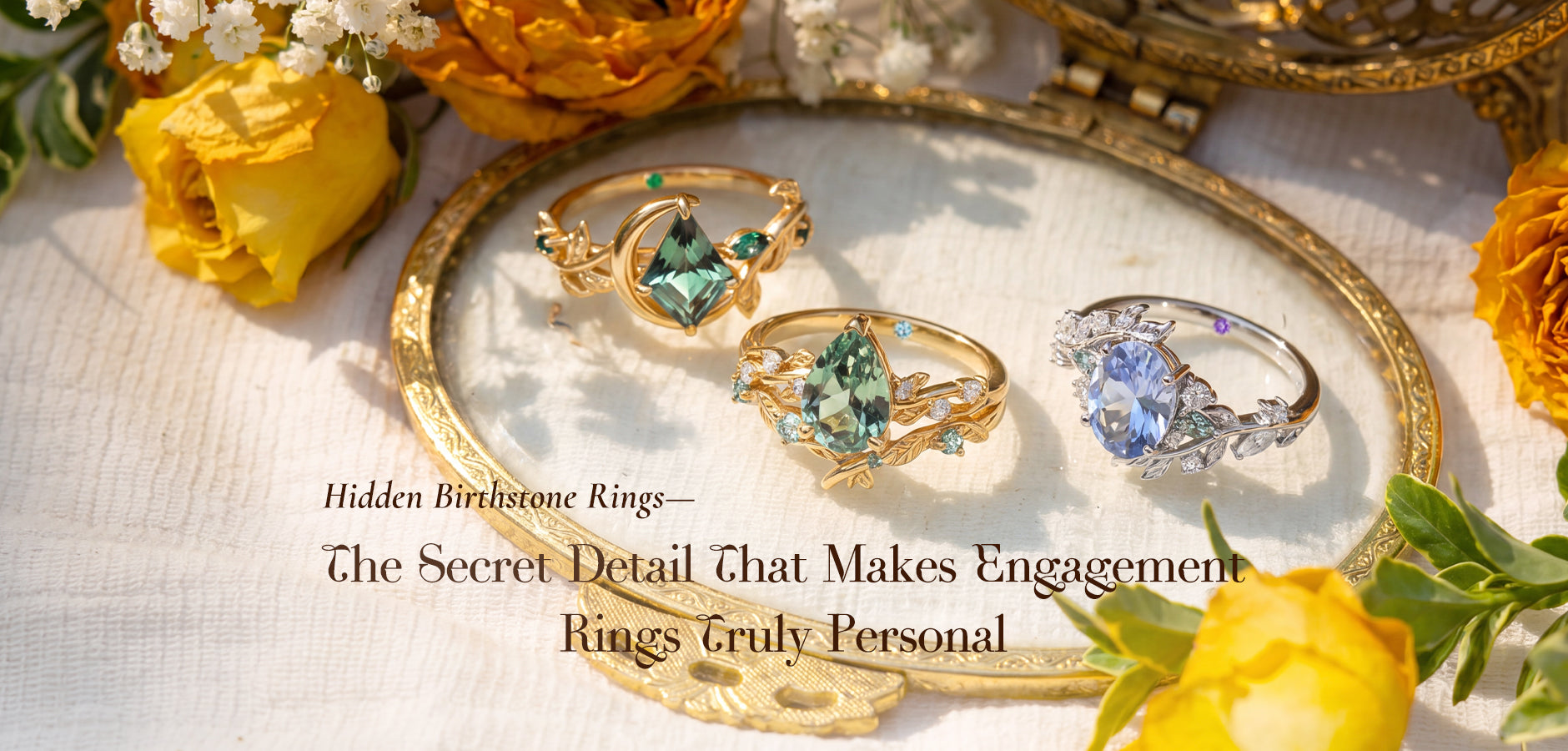
Clarissa — Pear Cut Lab Green Sapphire Leafy Bridal Set
The Clarissa bridal set is a two-piece design that wraps nature around the finger. The engagement ring centers a pear-cut lab-grown green sapphire in a leaf-vein setting, while the matching band curves alongside it like a living vine. The leaf detailing creates natural junctions where a small hidden birthstone could nestle — a May emerald or June alexandrite tucked where the leaves meet the band, for example.
Specifications:
- Center stone: Lab green sapphire, 6×8mm, pear cut
- Accent stones: Moissanites and moss agates, D clarity, VS–VVS color, 0.25ct total weight
- Band width: 1.6mm
- Metal: 14K or 18K solid gold or platinum (yellow, white, rose, or black gold)
- Includes matching curved band
Helene — Kite Cut Lab Green Sapphire Crescent Moon & Leaf Engagement Ring
The Helene ring combines two of nature's most poetic symbols: the crescent moon and the leaf. A kite-cut lab green sapphire sits at the center, framed by a setting that curves like a crescent moon on one side and extends into delicate leaves on the other. The moon-and-leaf motif creates multiple natural hiding spots for a birthstone — inside the curve of the moon, or where the leaves converge along the band.
Specifications:
- Center stone: Lab green sapphire, 6×9mm, kite cut (1.5ct)
- Accent stones: Lab emerald, D clarity, VS–VVS color, 0.35ct total weight
- Band width: 1.6mm
- Metal: 14K or 18K solid gold or platinum (yellow, white, rose, or black gold)
Abrielle — Oval Cut Lab Cornflower Blue Sapphire Vine Fairytale Engagement Ring
The Abrielle ring is a fairytale in metal and stone. An oval-cut lab cornflower blue sapphire — a gemstone that embodies the "something blue" tradition on its own — sits in a setting where delicate vine-inspired details wrap gracefully around the band. The vine work creates natural channels and curves that can conceal a birthstone within the organic flow of the design. In white gold, the cornflower blue sapphire reads as classic and elegant; the vine details add a layer of natural romance that makes the ring feel both timeless and deeply personal.
Specifications:
- Center stone: Lab cornflower blue sapphire, 6×8mm, oval cut
- Accent stones: Moissanites, D clarity, VS–VVS color, 0.25ct total weight
- Band width: 1.6mm
- Metal: 14K or 18K solid gold or platinum (yellow, white, rose, or black gold)


Design Your Own Hidden Birthstone Ring with BlingFlare
At BlingFlare, every piece is designed with nature as the starting point — and nature, by its very character, is full of hidden details. The curve of a leaf, the arc of a crescent moon, the weave of a vine — these organic forms create natural pockets and channels where a birthstone can be concealed as though it grew there.
If you're interested in incorporating a hidden birthstone into a BlingFlare design, the team can help you explore options:
- Leaf-inspired settings — A birthstone nestled where leaves converge
- Moon-inspired settings — A stone tucked within the crescent curve
- Botanical elements — A gemstone woven into vine or floral details
- Inner band placement — A birthstone set into the interior of the band for maximum privacy
BlingFlare's engagement ring collection offers a wide range of nature-inspired designs that can be adapted to include your personal birthstone detail. Reach out to the team to discuss your vision — there's no obligation, and the consultation process is designed to help you find the right balance of beauty, meaning, and wearability.
Related Reads
- The Ultimate Guide to Birthstones: Meaning, History & How to Choose Yours
- The Meaning Behind Gemstone Rings: How to Choose the Perfect Stone
- 5 Customization Tips for Personalized Gemstone Couple Rings
FAQ
What is a hidden birthstone engagement ring?
A hidden birthstone engagement ring features a small gemstone corresponding to a birth month — concealed in a discreet location such as beneath the center stone, inside the band, or integrated into the ring's decorative details. The stone is a personal touch visible only to the wearer or upon close inspection.
Where can a birthstone be hidden in an engagement ring?
There are three common placements: beneath the center stone (visible from certain angles), inside the band (visible only when the ring is removed), and integrated into design elements like leaves, vines, or moon motifs. Each placement offers a different level of visibility and intimacy.
What birthstone should I choose for my partner?
The most common approach is choosing your partner's birth month gemstone. However, some couples choose the month they met, the month of their first date, or another milestone date. The "right" stone is the one that carries meaning for your specific story.
Can I add a hidden birthstone to any ring design?
In many cases, yes. Nature-inspired designs with leaf, vine, or moon elements naturally create hiding spots for small accent stones. Simpler designs can accommodate inner-band placements. The BlingFlare team can assess whether a specific design can incorporate a hidden birthstone.
Are lab-grown gemstones suitable for hidden birthstones?
Absolutely. Lab-grown gemstones have the same chemical composition, hardness, and optical properties as their mined counterparts. They're an excellent choice for hidden birthstones — ethically sourced, physically identical, and often more affordable, which matters for small accent stones.
How much does it cost to add a hidden birthstone?
The cost depends on the gemstone type, size, and placement. Small accent stones (1–3mm) are relatively modest additions. The primary cost factor is the gemstone itself — a small sapphire costs significantly less than a small diamond. Contact BlingFlare for specific pricing based on your design preferences.
Can I choose a birthstone that isn't my birth month?
Yes. While traditional birthstones are tied to specific months, there's no rule against choosing a stone that carries personal meaning for other reasons — a favorite color, a symbolic quality, or a connection to a shared experience. The meaning you assign to the stone is what matters.
Which birthstones are most durable for everyday ring wear?
Sapphire and ruby (both 9 on the Mohs scale) are the most durable options for rings worn daily. Alexandrite (8.5) is also very durable. Emerald and aquamarine (7.5–8) require more care. Pearl and opal are too delicate for everyday ring wear and are better suited to pendants or earrings.