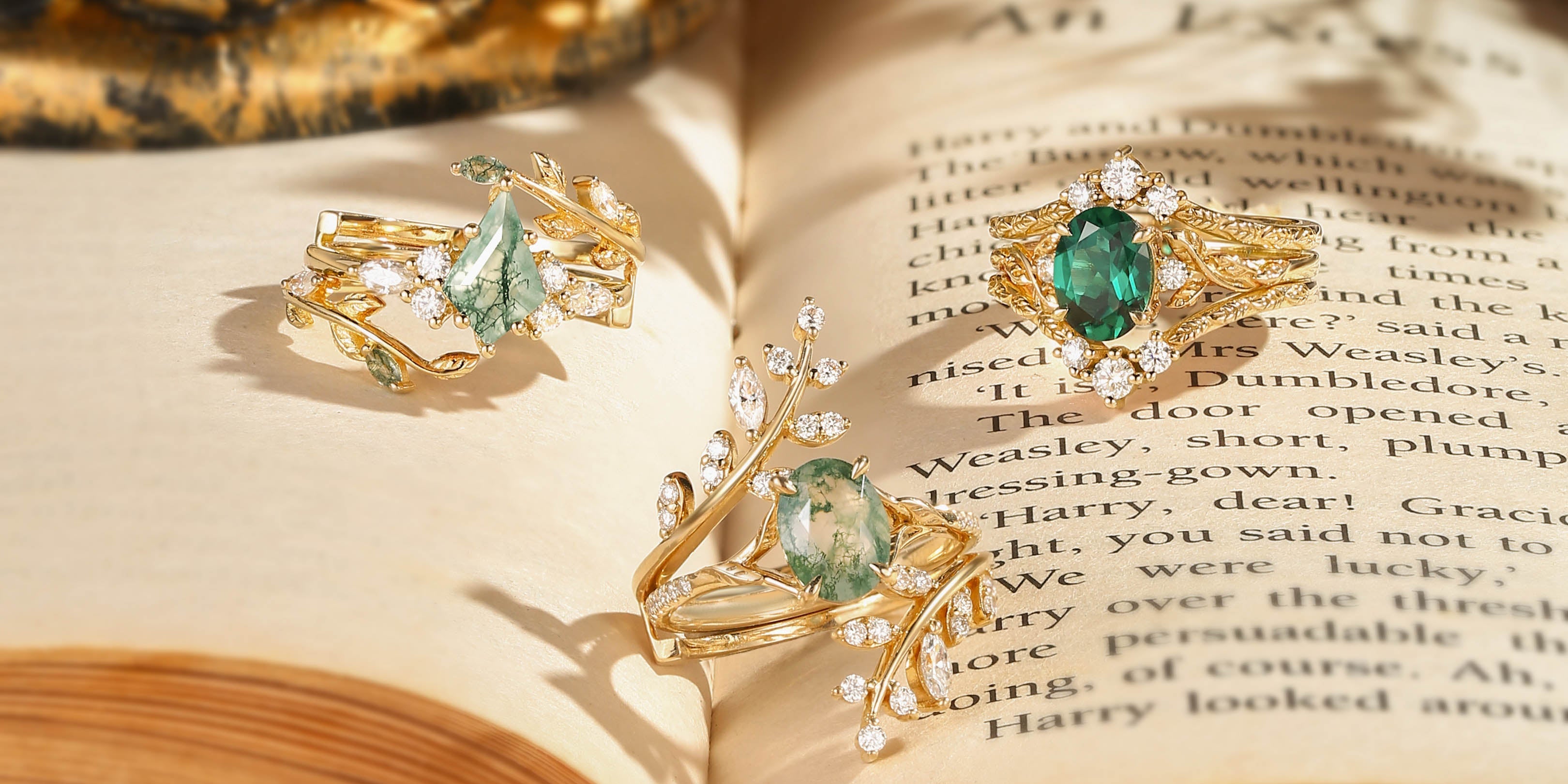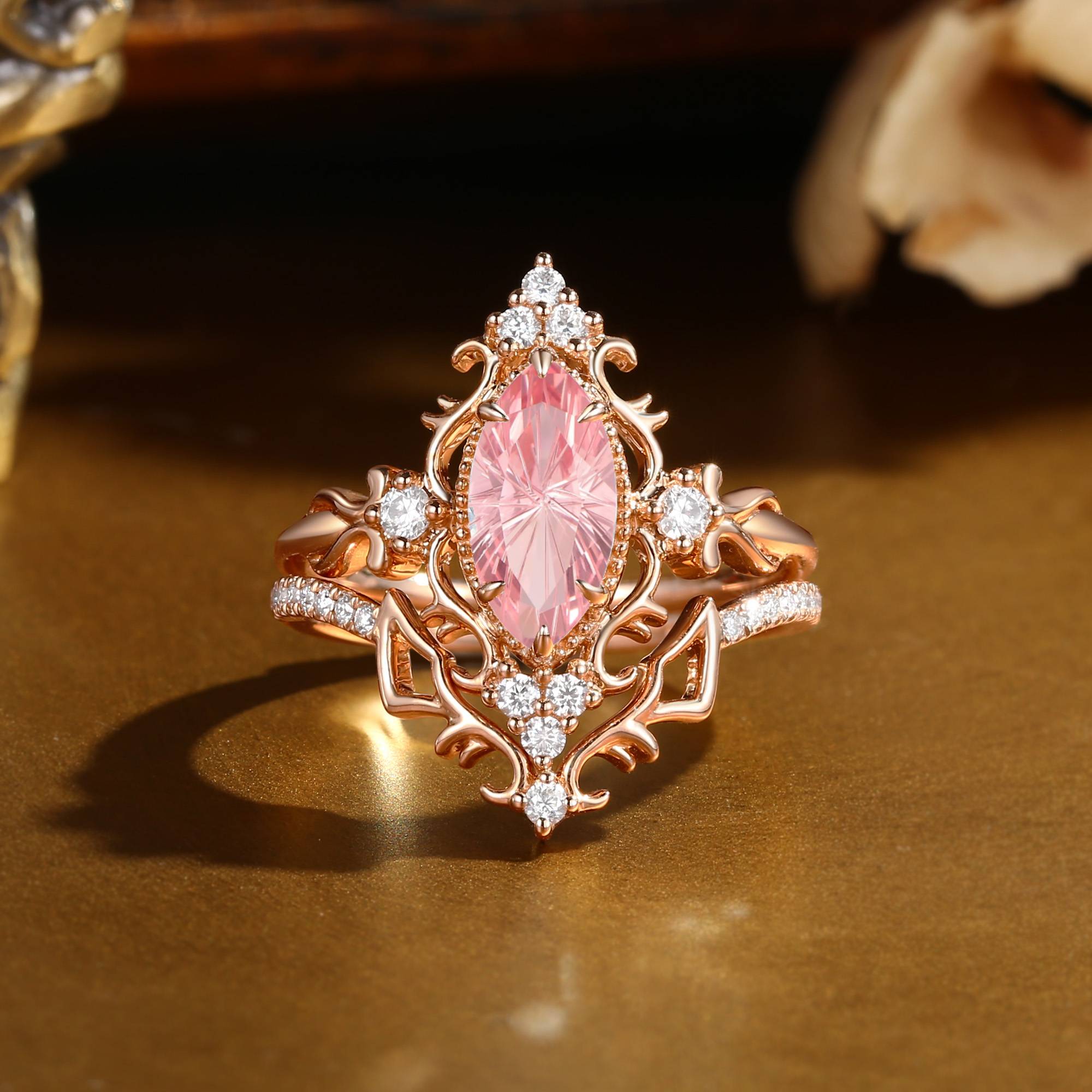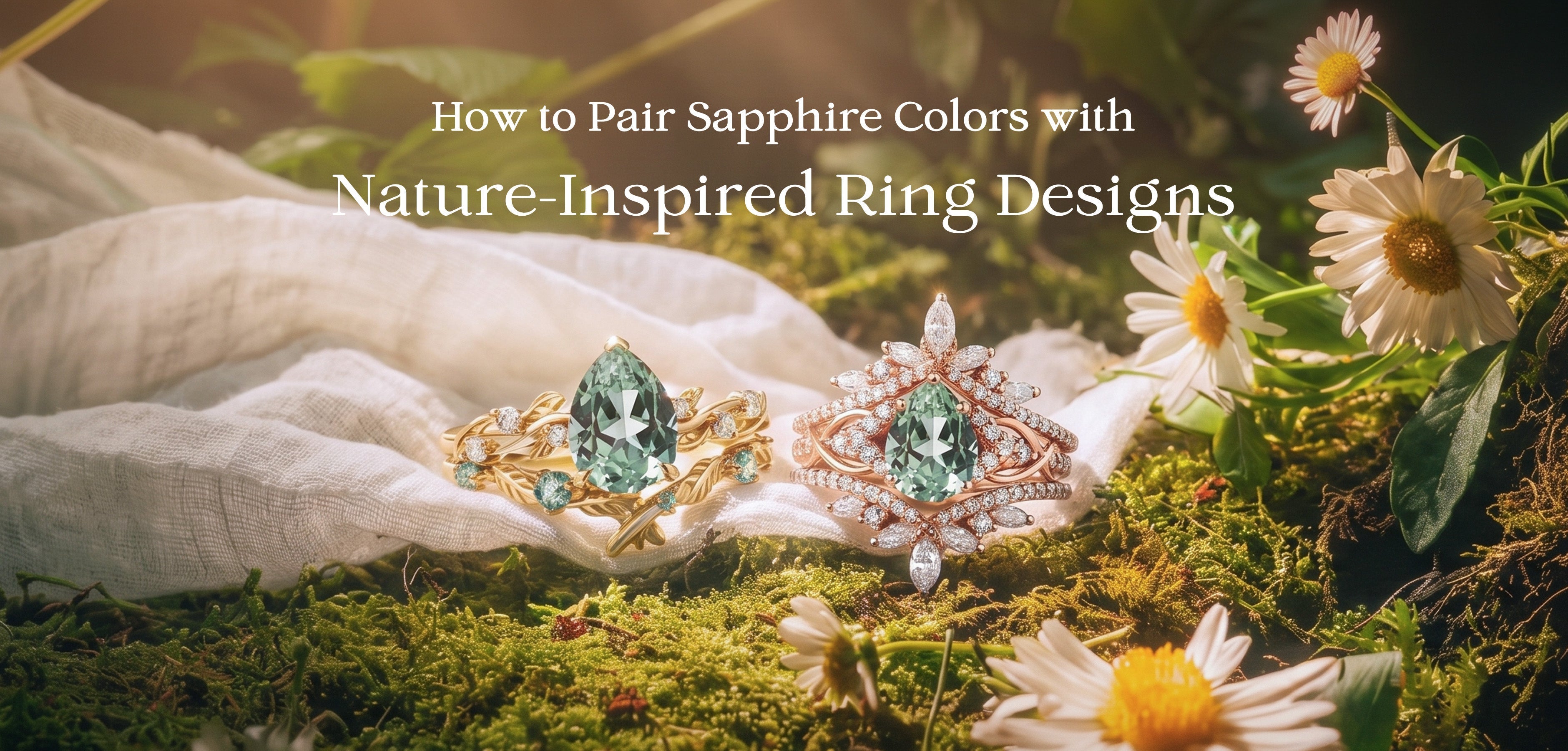
Put the same sapphire into two completely different ring settings, and you'll get two entirely different pieces of jewelry. A royal blue stone in a sleek modern bezel reads power and precision; place that identical gem into a hand-carved leaf setting with twisting vine shoulders, and suddenly it feels like something unearthed from an enchanted forest. That's the magic of nature-inspired rings — they don't just hold a gemstone, they give it a story.
At BlingFlare, botanical motifs have been a signature since day one: leaf-vein bezels, organic vine bands, floral halos that bloom around the center stone. And no gemstone benefits more from this design philosophy than the sapphire. Rated 9 on the Mohs hardness scale — second only to diamond — sapphires are durable enough for everyday wear, while their extraordinary range of colors offers an almost limitless palette for creative jewelry design. In this guide, we'll walk you through four stunning color-and-design pairings that bring out the very best in sapphire engagement rings, so you can find the combination that matches not just your taste, but your personality.
Table of Contents
- Why Nature-Inspired Settings Belong with Sapphires
- Royal Blue × Vintage Leaf — Power and Romance
- Cornflower Blue × Floral — Soft and Romantic
- Green Sapphire × Forest-Inspired — Wild and Alive
- Teal Sapphire × Organic Vine — Mysterious and Moody
- Which Pairing Is Right for You?
- FAQ
Why Nature-Inspired Settings Belong with Sapphires
Before we dive into specific pairings, it's worth understanding why nature-inspired settings and sapphires feel so naturally right together.
Origin story. Sapphires are born deep inside the Earth's crust, formed under intense heat and pressure over millions of years. They are, quite literally, children of the earth. When you set a sapphire into a band carved with leaf veins, winding stems, or woodland textures, you're echoing the gemstone's own geological origin. The visual language matches the literal one.
Softening geometry. Sapphires are often cut into precise geometric shapes — ovals, pears, cushions — with crisp facets that catch light at sharp angles. A nature-inspired setting, with its flowing curves and organic asymmetry, creates a beautiful tension against that geometric precision. The curved tendrils of a vine band frame the stone's clean lines; a leafy bezel softens the transition between gem and metal. The result is a ring that feels both structured and alive.
Timelessness over trend. Nature motifs have appeared in jewelry for centuries — from Art Nouveau masterpieces to Victorian botanical brooches — and they never feel dated. Sapphires, too, transcend fashion cycles. A sapphire set in a botanical ring design is a piece that won't feel "of an era" in ten or twenty years. It simply feels enduring, like the natural world that inspired it.
The BlingFlare approach. At BlingFlare, nature isn't just a decorative afterthought — it's the design DNA. Leaf-vein settings trace the delicate branching patterns of real foliage. Organic vine bands twist and interweave like living stems. Floral halos bloom petal by petal around the center stone. Every curve is considered, every texture intentional. This isn't costume jewelry with a leaf stamped on it; it's jewelry that grew.
Royal Blue × Vintage Leaf — Power and Romance
Picture this: a deep, velvety blue that seems to absorb light rather than reflect it. A ring band etched with the kind of intricate leaf pattern you'd find on a cathedral door in old Europe. This is the pairing for those who want their jewelry to carry weight — not just in carats, but in presence.
Royal Blue sapphires sit at the deepest end of the blue spectrum. Their color comes from trace amounts of iron and titanium within the corundum crystal structure, and the finest specimens display a vivid, saturated blue with a subtle violet undertone. Historically, Royal Blue sapphires have been the stones of kings and clergy — think of the St. Edward's Sapphire in the British Crown Jewels, or the famous Logan Sapphire at the Smithsonian.
The depth and gravitas of a Royal Blue sapphire calls for a setting with equal visual richness. Vintage leaf designs deliver exactly that. The finely carved veins and overlapping foliage create a surface texture that's complex enough to hold its own against such an intense color. Where a minimalist setting might let a Royal Blue feel stark or cold, vintage leaf work wraps the stone in warmth and narrative — it becomes a gem discovered in a forgotten garden, not a stone displayed under a spotlight.
Best metal pairing: Yellow Gold. The warm, honeyed tones of yellow gold create a rich complementary contrast with deep blue. This is the color theory principle of warm-cool opposition at work: gold's warmth makes the blue appear even deeper, while the blue keeps the gold from feeling too sweet. In a vintage leaf setting, yellow gold also enhances the antique quality of the metalwork, making the entire ring feel like a genuine heirloom.
The vibe: Royalcore meets dark academia. This pairing is for the woman who walks into a room and the room notices. It's power, but power with a plot — romantic, literary, a little mysterious.
Cornflower Blue × Floral — Soft and Romantic
Imagine the first warm morning of spring. Dew on petals. A sky that isn't quite blue — it has a whisper of violet in it, like someone watered down a watercolor. That's Cornflower Blue.
Cornflower Blue is perhaps the most poetic of all sapphire colors. Named after the Centaurea cyanus flower — the cornflower — this shade sits lighter and softer than Royal Blue, with a distinctive silky luminosity and a delicate violet secondary hue. The color comes from a very specific balance of iron and titanium impurities, and the finest cornflower sapphires (particularly from Kashmir) are among the most prized gemstones on Earth.
If Royal Blue is about depth and power, Cornflower Blue is about lightness and luminosity. And that's exactly why it pairs so beautifully with floral designs. A floral halo — where tiny petals of metal or accent stones surround the center sapphire like a blooming flower — doesn't compete with the stone's softness; it amplifies it. The overall effect is a ring that looks like it was dreamed up in a garden at dawn.
Best metal pairing: Rose Gold or White Gold. Rose gold is the romantic's choice here. Its pink-copper warmth plays into the gentle, feminine energy of a Cornflower Blue sapphire, creating a pastel harmony that feels like spring captured in metal and gem. White gold, on the other hand, keeps the palette cool and ethereal — think frost on flower petals rather than sunlight on them. Both are stunning; the choice depends on whether you want warmth (rose) or crystalline clarity (white).
The vibe: Soft-girl aesthetic meets Bridgerton romance. This is the pairing for someone who cries at weddings (happy tears), loves pressed flowers in books, and wants their engagement ring to feel like a love letter.


Green Sapphire × Forest-Inspired — Wild and Alive
You're walking through an old-growth forest. Sunlight breaks through the canopy in shards, hitting moss-covered branches, fern fronds, lichen on stone. Everything is green — but not one uniform green. There's emerald, sage, olive, chartreuse, the deep near-black green of wet moss. Now imagine capturing that living, breathing green in a gemstone and setting it into a ring that looks like it grew right out of the forest floor.
Green sapphires are one of the most underappreciated colors in the sapphire family. Their color comes primarily from iron — specifically, Fe²⁺ and Fe³⁺ ions within the corundum lattice — without the titanium that creates blue. The result is a green that ranges from pale sage to deep forest, often with subtle yellow or blue undertones that shift in different lighting. Unlike emeralds (which are notoriously included and fragile at 7.5–8 on the Mohs scale), green sapphires bring the full 9 hardness rating of corundum, making them exceptionally practical for everyday jewelry.
No other sapphire color calls for a nature-inspired setting quite like green. The connection is almost too perfect: a green gemstone born from the earth, set into a band that mimics the very forests where that earth comes alive. Leaf settings become literal echoes of the stone's color story. Vine bands wrap around the finger like ivy. The overall effect isn't just "pretty" — it's immersive. You're not wearing a ring; you're wearing a landscape.
Best metal pairing: White Gold or Black Gold. White gold provides a clean, cool frame that lets the green sapphire's natural color take center stage — it's the visual equivalent of a white gallery in a museum. Black gold (rhodium-plated or PVD-coated) creates a dramatic, moody contrast that pushes the forest vibe into darker, more mysterious territory. Both allow the green to remain the hero.
Featured Piece: Clarissa
The Clarissa is everything this pairing is about. A pear-cut lab green sapphire (6×8mm) sits at the center of a leafy bridal set that looks like it was growing before it was made. The main stone is flanked by shimmering moissanite and grounded by moss agate — yes, moss agate, a stone that literally contains mineral inclusions resembling tiny landscapes. The band traces delicate leaf veins in solid 14K or 18K gold, wrapping the finger in organic texture. Starting at $1,349, this 2-piece bridal set proves that a nature-inspired engagement ring doesn't have to mean compromising on luxury.


Featured Piece: Jasmine
If the Clarissa is the forest at dawn, the Jasmine is the forest at dusk — richer, more elaborate, with a sense of quiet drama. This vintage enhancer design features a pear-cut green sapphire (6×9mm, slightly larger than the Clarissa) set into a twist band that spirals like a tendril reaching for sunlight. accented with 0.28ct of moissanite that catches light like morning dew. The vintage enhancer silhouette — a design technique originally popular in the Edwardian era — creates a regal, elongated profile on the finger, while the twist detail keeps everything feeling organic and alive. In solid 14K or 18K gold, starting at $2,999, this is a statement piece for someone who wants their ring to be unforgettable.


Teal Sapphire × Organic Vine — Mysterious and Moody
There's a moment just before night falls when the ocean turns a color you can't name. It's not blue. It's not green. It's something in between — something ancient and depthless and impossible to look away from. That's teal.
Teal sapphires occupy one of the most fascinating and unusual positions in the sapphire color spectrum. They contain both iron (which creates blue) and a secondary influence that pulls toward green, resulting in a blue-green that shifts and changes depending on the light. In daylight, a teal sapphire might read more blue; under warm evening light, the green emerges. It's a gemstone that refuses to be pinned down — and that's precisely its appeal.
The reason teal sapphires pair so beautifully with organic vine designs is movement. Vine settings are all about flowing, intertwining lines — they spiral, they curve, they wander. And teal sapphires have the same fluid quality in their color: a sense of motion between blue and green, never settling, always shifting. The visual rhythm of a vine band mirrors the visual rhythm of the stone itself.
Best metal pairing: White Gold. A cool-toned white gold setting provides a neutral canvas that lets the teal sapphire's complex color do all the talking. Yellow gold can work too, but it risks warming the stone too much and pushing the color toward green. White gold keeps the blue-green tension intact.
The vibe: Oceanic. Otherworldly. This is the pairing for someone who collects sea glass, whose favorite color changes daily (is it blue? is it green? it's both), and who wants an engagement ring that makes people ask, "Wait, what kind of stone is that?" — followed by the best answer: "It's a teal sapphire."
[PLACEHOLDER: Teal Sapphire Organic Vine product images — carousel would feature blue-green teal sapphires set in swirling vine-inspired white gold bands]
Quick Pairing Guide
| Sapphire Color | Design Style | Vibe | Best Metal |
|---|---|---|---|
| Royal Blue | Vintage Leaf | Power & Romance | Yellow Gold |
| Cornflower Blue | Floral Halo | Soft & Dreamy | Rose Gold |
| Green Sapphire | Forest / Leafy | Wild & Alive | White / Black Gold |
| Teal Sapphire | Organic Vine | Moody & Unique | White Gold |
Which Pairing Is Right for You?
Still not sure which color-and-design combination speaks to you? Let's skip the gemology for a moment and talk about you.
If you're drawn to power, history, and timeless elegance — the kind of woman who looks as stunning in a little black dress as she does in vintage denim — Royal Blue × Vintage Leaf is your match. It's bold without being loud, romantic without being soft. It says: I know who I am.
If your heart belongs to soft mornings, flower markets, and anything with a hint of lavender — if your idea of luxury is a garden picnic with real china — Cornflower Blue × Floral will make you feel at home. It's the engagement ring equivalent of your favorite love song.
If you've never met a forest you didn't want to wander into — if you'd rather hike than brunch, and your plant collection has its own zip code — Green Sapphire × Forest-Inspired was made for you. This is the ring for rule-breakers and nature worshippers. The Clarissa and Jasmine sets above are just the beginning.
If you're the friend everyone describes as "unique" — if your aesthetic lives somewhere between stormy seas and midnight gardens — Teal Sapphire × Organic Vine is the pairing that will make you feel truly seen. It's different. It's unmistakable. It's you.
A Word from BlingFlare
At BlingFlare, we believe the most beautiful jewelry doesn't just decorate — it connects. Connects you to the natural world that inspired it. Connects you to the craftsperson who shaped every leaf vein and vine tendril by hand. Connects you to a story that's yours alone. Our nature-inspired sapphire collection is built on this belief: that a ring should feel like it grew, not like it was manufactured. Every setting, every curve, every choice of metal is designed to let the sapphire's natural beauty breathe and bloom. Whether you're drawn to the deep romance of Royal Blue, the dreamy softness of Cornflower, the wild aliveness of Green, or the mysterious allure of Teal — there's a nature-inspired ring here waiting to become part of your story.
Related Reads
- Why Sapphire Stays Brilliant: The Everyday Stone That Never Stops Catching Light
- On Cornflower Sapphires and the Color We Keep Coming Back To
- Wedding Season 2026: Which Engagement Ring Stone Is Right for You?
FAQ
What is the most popular sapphire color for nature-inspired rings?
Green sapphires are the most popular choice for nature-inspired ring designs, thanks to their direct visual connection to foliage, moss, and forest landscapes. Royal Blue sapphires are a close second, particularly in vintage leaf settings. However, the "best" color is always the one that resonates with you personally — sapphires come in nearly every color, and nature-inspired settings are versatile enough to complement the full spectrum.
Are lab-grown sapphires as good as natural ones?
From a scientific standpoint, yes — completely. Lab-grown sapphires have the same chemical composition (aluminum oxide, Al₂O₃), the same crystal structure, the same hardness (9 on the Mohs scale), and the same optical properties as natural sapphires. The only difference is origin: lab sapphires are grown in controlled environments over weeks rather than formed in the earth over millions of years. This means they offer identical beauty and durability at a significantly lower price point, with a smaller environmental footprint. Many gemologists consider them an excellent choice for engagement rings.
What is a "leafy" ring setting?
A "leafy" ring setting is a type of nature-inspired jewelry design where the metal band and/or bezel is carved, textured, or shaped to resemble leaves, leaf veins, and botanical forms. The metalwork mimics the delicate branching patterns of real foliage — often with raised veins, overlapping leaf shapes, and organic curves. It's different from a simple stamped leaf motif; a true leafy setting involves three-dimensional metalwork that creates depth and texture around the gemstone.
How do I care for a sapphire ring with intricate metalwork?
Nature-inspired rings with detailed leaf veins, vine textures, or floral elements need a bit more care than smooth bands. Clean your ring weekly with warm soapy water and a soft toothbrush — the bristles can reach into textured crevices where lotion and oils accumulate. Avoid ultrasonic cleaners if your ring includes accent stones like moss agate or opals. Remove the ring before swimming (chlorine can dull gold over time) and before applying lotions or perfumes. Store it in a soft pouch separately from other jewelry to prevent the textured metalwork from scratching other pieces. With proper care, your sapphire ring will stay beautiful for a lifetime — the stone itself will last essentially forever.
Does BlingFlare offer custom sapphire ring designs?
Yes! BlingFlare specializes in customizable nature-inspired sapphire rings. You can choose your preferred sapphire color, cut, and size, then pair it with one of our signature design styles — leafy, vine, floral, or forest-inspired. Metal type (14K or 18K yellow gold, rose gold, white gold, or black gold) and accent stones can also be customized. Visit blingflare.com or reach out to our design team to start creating your one-of-a-kind nature-inspired sapphire ring.
What sapphire color is the most durable for everyday wear?
All sapphires — regardless of color — share the same hardness of 9 on the Mohs scale, making them equally durable for everyday wear. The color of a sapphire is determined by trace element impurities (iron, titanium, chromium, etc.) that don't affect the stone's structural integrity. Whether you choose Royal Blue, Cornflower Blue, Green, or Teal, your sapphire will be scratch-resistant and tough enough for a lifetime of daily wear. The only consideration is the setting style: intricate nature-inspired designs with raised textures may show wear slightly faster than smooth bands, but the gemstone itself will remain pristine.