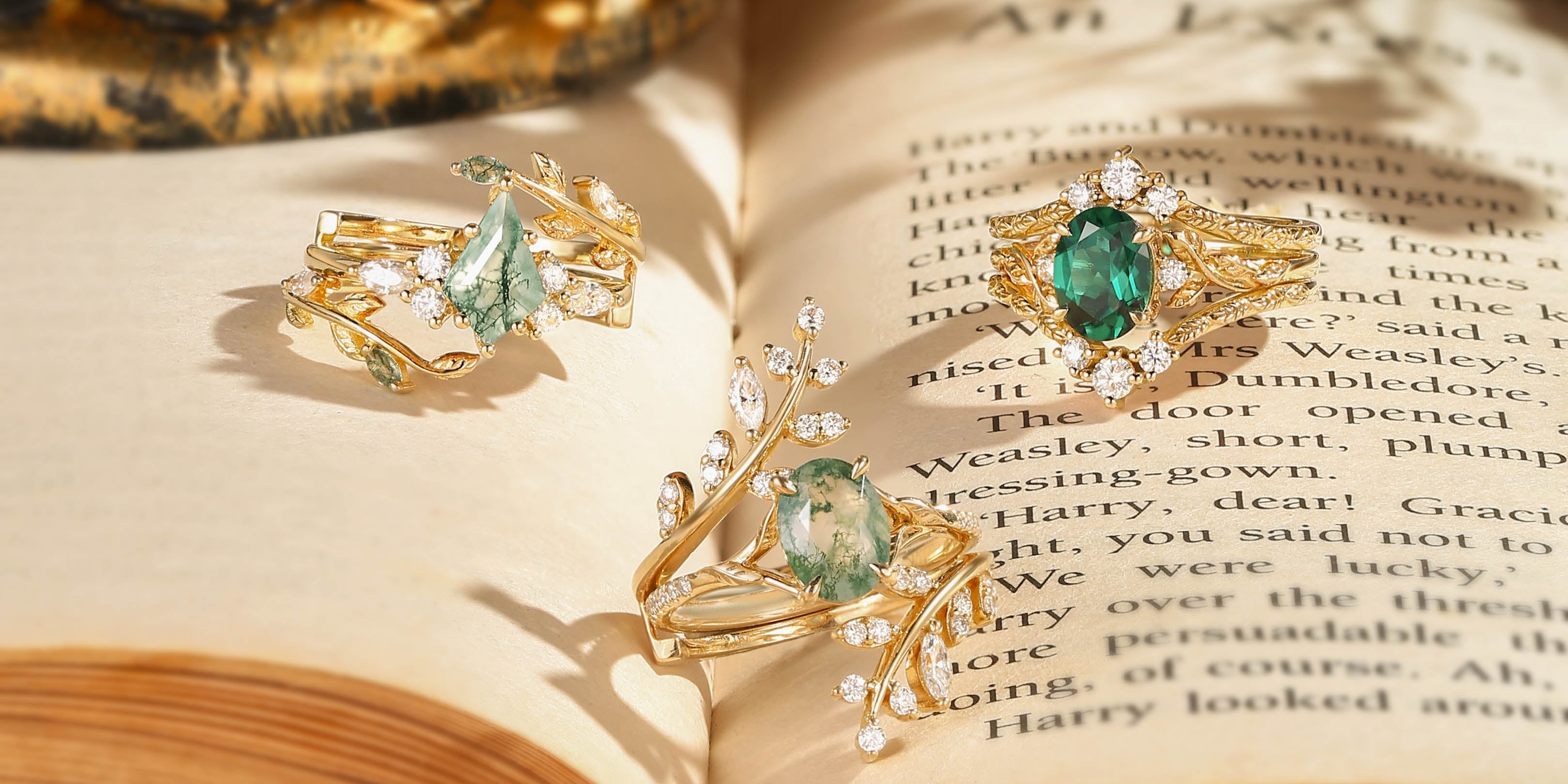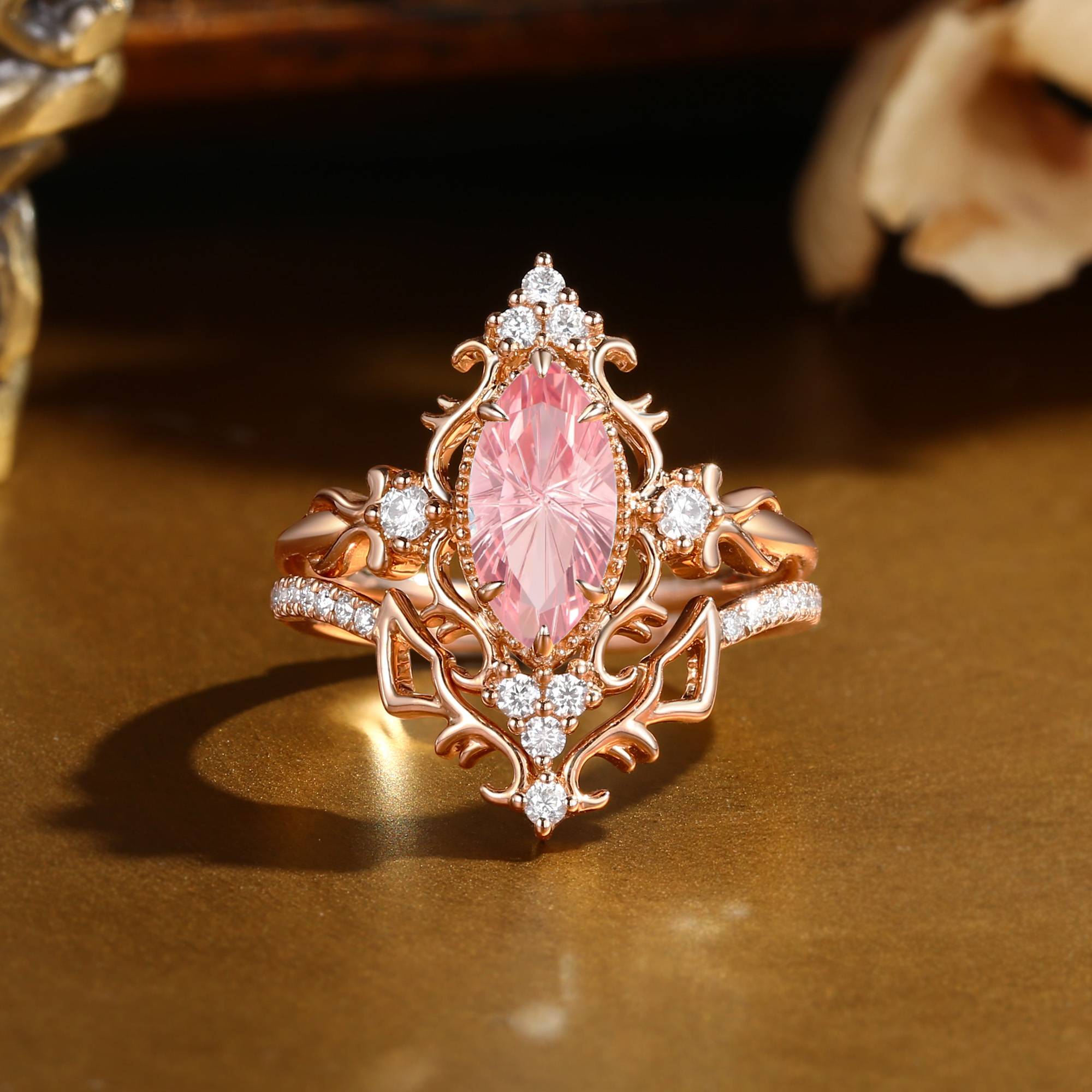
There was a time when couple wedding bands were expected to be identical — same metal, same width, same polished finish, as though love demanded uniformity. Those days are behind us. Today's couples are choosing couple rings that echo one another rather than clone one another: two distinct designs bound by a shared material, a matching engraving, or a complementary motif. A black tungsten band for one, a gold leaf-engraved ring for the other. A moss agate inlay for her, a kite-cut green sapphire for him. The result is something far more honest — two individuals who happen to be choosing the same forever, expressed through rings that look different but belong together.
This guide walks through why more couples are moving away from perfectly matched sets, how to design two rings that feel like a conversation rather than a chorus, and where to find handmade, nature-inspired wedding bands that honor each person's style without losing the connection between them. Whether you are shopping for unique wedding bands for couples for the first time or redesigning a set that already exists, you will leave with a clear idea of how to make two rings tell one story.
Table of Contents
- Beyond the Traditional Wedding Band
- Two Rings, One Love Story
- The Beauty of Contrasting Designs
- Finding the Perfect Balance Between Two Styles
- Discover BlingFlare's Couple Rings
Beyond the Traditional Wedding Band
For decades, the standard advice was straightforward: pick a jeweler, choose a style, order two of the same ring in different sizes. It was efficient, it was safe, and it left almost no room for personality. A couple who spent their weekends hiking in the Pacific Northwest ended up with the same polished gold band as a couple who met at a punk-rock vinyl fair. The ring said nothing about them except that they were married.
The shift away from identical matching sets did not happen overnight. It began slowly — with one partner requesting an engraving the other did not have, or choosing a different metal tone because one wardrobe leaned silver and the other gold. Over the past decade, that quiet rebellion has become a movement. Jewelers now report that a growing share of couples walk into the store wanting two rings that complement without copying, and designers have responded with collections built around that very idea.
Three forces are driving this change. The first is individuality. Modern couples are building lives that feel intentionally curated — from co-created wedding ceremonies to shared travel blogs — and their rings are an extension of that ethos. The second is aesthetic confidence. People today wear jewelry the way they wear clothing: as an expression of self, not a uniform. The third is the rise of handmade and nature-inspired design, which gives couples an almost limitless palette of textures, stones, and motifs to draw from. When your options include hand-engraved vines, enamel mountain landscapes, moss agate inlays, and kite-cut sapphires, choosing two of the same ring suddenly feels like a missed opportunity.
None of this means that tradition is wrong. A matching set can be beautiful, and for some couples it is exactly right. But for those who want their rings to carry more personal meaning — to say "we are different, and that is the point" — the world of unique wedding bands for couples has never been more welcoming.


Two Rings, One Love Story
The most compelling couple rings do not match — they converse. One ring might speak in broad strokes: a wide band, a bold inlay, a dark metal. The other responds in quieter detail: a narrow band, a delicate engraving, a lighter tone. Together they create a dialogue that neither ring could carry alone, and the listener — the couple wearing them — is the only one who truly understands the full exchange.
Think of it like the way a great relationship works. Two people do not have to be the same to belong together. They share values, inside jokes, a rhythm of daily life. Their rings can work the same way. A shared engraving — coordinates of where you met, a word only the two of you know, the date in Roman numerals — ties two different designs together invisibly. A shared metal, even if the finishes differ, creates a visual thread. A shared motif — leaves on one ring, vines on the other; a moon on hers, a sun on his — turns two separate pieces into a single illustrated story.
This approach works especially well when one partner wears jewelry daily and the other rarely does. The minimalist partner might choose a slim, polished band in a durable metal. The expressive partner might choose a wide, engraved, gemstone-accented ring. Both are happy. Both feel like themselves. And when the rings sit side by side in a velvet box, the design echoes — same leaf motif, same engraving font, same warm gold tone — make it clear they belong to the same story.
The key is intentionality. Before choosing, sit down together and name the elements you want to share: metal family, engraving style, a motif, a stone, a color. Then each of you takes those shared elements and interprets them in your own way. The result is never matchy-matchy. It is coherent — the way a good love story is coherent.


The Beauty of Contrasting Designs
Contrast is where the magic lives. When two rings differ — in metal, in texture, in stone, in color — each ring becomes more interesting precisely because of the difference. A black band makes a gold band feel warmer. A matte finish makes a polished surface feel more luminous. A rugged, landscape-engraved ring makes a delicate, gemstone-set ring feel more refined. The eye is drawn to the interplay, and the story deepens.
Here are the most popular ways couples build contrast into their rings, along with the design effect each one creates:
| Contrast Element | Example | Design Effect |
|---|---|---|
| Metal color | Black gold for one partner, warm yellow gold for the other | Creates a bold visual dialogue; dark vs. light, modern vs. classic |
| Surface texture | Hammered or raw finish vs. high-polish mirror | Adds tactile depth; rugged vs. refined |
| Gemstone choice | Moss agate inlay for one, kite-cut green sapphire for the other | Each stone carries personal meaning while sharing a nature-inspired palette |
| Band width | A wide 8mm band paired with a delicate 3mm band | Balances presence and comfort; statement vs. subtle |
| Engraving style | Mountain landscape on one ring, fine vine scrollwork on the other | Tells two halves of the same outdoor story |
| Finish technique | Enamel inlay in deep blue or forest green vs. bare metal | Introduces color that feels painterly and personal |
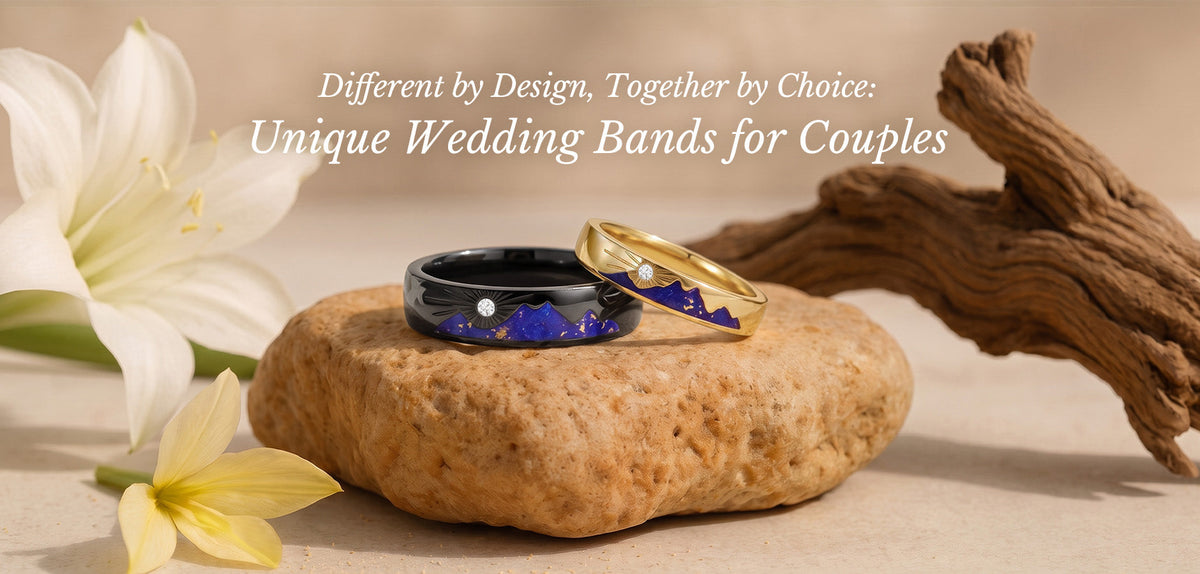
The Mountain Inspired Enamel Sun Design Couple Ring is a perfect example of contrast done right. One band carries a hand-engraved mountain landscape finished in black gold, dramatic and bold. Its partner responds in warm yellow gold with a polished sun motif and delicate vine detailing — feminine without being fragile. Together they evoke the landscape a couple might have hiked through on a first trip, or the view from the place they got engaged. No two wearers will read the same story into those rings, and that is the point.
Moss agate has become one of the most beloved stones for couple rings because it naturally embodies contrast. Each moss agate slab looks like a tiny landscape — green tendrils suspended in translucent quartz, no two alike. In the Moss Agate Inlay Engraved Anniversary Promise Couple Rings, a wide yellow gold band cradles a polished moss agate inlay like a window into a forest floor, while its matching companion ring features fine vine engraving and a slender leaf-shaped inlay of the same stone. One ring is a landscape; the other is a single branch. Together they feel like a field guide to a relationship.
Other couples lean into color contrast through enamel inlays — deep sapphire blue, forest green, or even burgundy — paired with bare metal on the partner's ring. The enamel adds a painterly quality that shifts in different light, while the bare metal keeps one ring grounded and classic. It is a technique that borrows from centuries of jewelry tradition and feels completely fresh at the same time.
And then there is hand engraving, which adds a layer of meaning no machine can replicate. A couple who met in the mountains might choose a ridgeline engraving on his band and a wildflower border on hers. A couple who shares a love of astronomy might engrave a constellation on one ring and a crescent moon on the other. The technique is ancient, but the stories are always brand new.


Finding the Perfect Balance Between Two Styles
Designing two rings that feel different yet connected is a balancing act. Lean too far toward contrast and the pair feels random; lean too far toward matching and you lose the individuality you were after. Here is a framework for finding the sweet spot.
Start with one shared anchor. The simplest way to create coherence is to choose one element both rings will share. It could be the metal family (both yellow gold, one polished and one brushed), a motif (leaves, celestial symbols, geometric lines), or a finishing technique (hand engraving, milgrain edging, enamel accents). One shared anchor is usually enough — the rest of the design can diverge freely.
Play with width and proportion. If one partner has larger hands or prefers a bolder presence, a wider band (6–8mm) gives the design room to breathe. The other partner might prefer a narrower band (3–4mm) that sits lighter on the hand. Width difference is one of the most natural ways to honor two different styles without sacrificing harmony, because the eye reads proportion before detail.
Consider how the rings stack. Many people now wear their couple ring alongside an engagement ring, a family heirloom, or simply another band they love. If stacking is part of the plan, choose a design that curves, notches, or contours around other rings. A curved wedding band paired with a straight band, for example, tells a subtle visual story about two things fitting together — which is, after all, the entire point.
Embrace custom design. When off-the-shelf options do not capture exactly what you are after, custom work opens every door. You can commission a jeweler to incorporate both partners' birthstones, to engrave a landscape that matters to both of you, or to design two rings that physically interlock when placed side by side. BlingFlare offers custom and personalized services — reach out with your ideas and the team will help bring them to life, with hand-selected stones and handmade-to-order craftsmanship.
Try before you commit. Most couples benefit from trying on a few different widths, textures, and metals before ordering. A ring that looks perfect online can feel too heavy, too light, or too ornate on the hand. If you are ordering custom or engraved pieces, ask about the jeweler's resizing policy — it can save a lot of stress later.
The goal is never to make two rings that match perfectly. The goal is to make two rings that, when placed side by side, feel inevitable — as though they could not belong to anyone else.
Discover BlingFlare's Couple Rings
At BlingFlare, couple rings and wedding bands are designed with one guiding principle: every relationship is a story, and every story deserves its own visual language. Our collection spans nature-inspired engravings, hand-painted enamel inlays, moss agate and sapphire gemstone accents, and vintage detailing — all handmade to order by artisans who treat every ring as a small piece of art.
We work with solid gold, black gold, and rose gold settings, and every gemstone is hand-selected and verified by our team before it becomes part of a design. We do not mass-produce. We do not rush. And we do not believe that a wedding band should look like everyone else's. Whether you are drawn to the quiet beauty of a moss agate inlay, the drama of a mountain landscape etched in black gold, or the sparkle of a star-set moissanite eternity band, our team will help you find — or design — a ring that fits your relationship as precisely as it fits your hand.
We also want the buying experience to feel as considered as the rings themselves. Here is what to expect:
- Free resizing for one year: We offer one free ring resizing within one year of purchase, up to ±1 size.
- 30-day returns for quality issues: If something is wrong with your ring due to a manufacturing issue, you may return it within 30 days.
- Change-of-mind returns: For personal (non-quality) reasons, returns are accepted with a 30% deduction.
- Custom and engraved pieces: Custom-made and engraved rings are final sale and cannot be returned.
Have an idea for a ring you have never seen anywhere else? Our custom design team loves a challenge. Send us a sketch, a mood board, or simply a description, and we will work with you to bring it to life — from stone selection to final polish.


Frequently Asked Questions
Do matching bands have to be identical?
Not at all. In fact, more and more couples are choosing rings that complement rather than copy. You can share a metal, a motif, or an engraving while each ring reflects the individual wearing it. The connection is in the details, not the duplication.
Can we choose different gemstones for our couple rings?
Yes. Many couples choose different stones that share a color family or a meaning. For example, one partner might wear a moss agate for its earthy, grounding energy, while the other chooses a green sapphire for its brilliance and durability. As long as both stones feel intentional, the combination works beautifully.
Is it okay if we pick different metals?
Absolutely. One partner may prefer the warmth of yellow gold while the other prefers the modern edge of black gold or the softness of rose gold. You can still create visual harmony by sharing a finishing technique — like hand engraving or milgrain — even if the metal tones differ.
How do we choose a couple ring set when we have very different styles?
Start by identifying one shared element — a metal family, a motif, or an engraving style — and let the rest of the design reflect each person's individual taste. A nature-inspired couple ring set, for example, might share a vine motif while one band is wide and textured and the other is narrow and polished. The shared thread makes the difference feel intentional.
What is the lead time for a custom or engraved couple ring set?
Because every ring at BlingFlare is handmade to order, lead times vary based on design complexity and gemstone availability. Most standard sets ship within two to four weeks. Custom designs and extensive engraving may take longer. Reach out to the team for a timeline estimate specific to your order.
Two rings. Two people. One story that belongs only to you. Whether you are drawn to the quiet strength of a moss agate inlay, the bold contrast of black and yellow gold, or the quiet poetry of a hand-engraved vine, BlingFlare is here to help you find — or design — a pair of rings that say everything you mean without saying a word. Begin your search here, or reach out with a custom idea. The most beautiful rings are the ones that could not belong to anyone else.