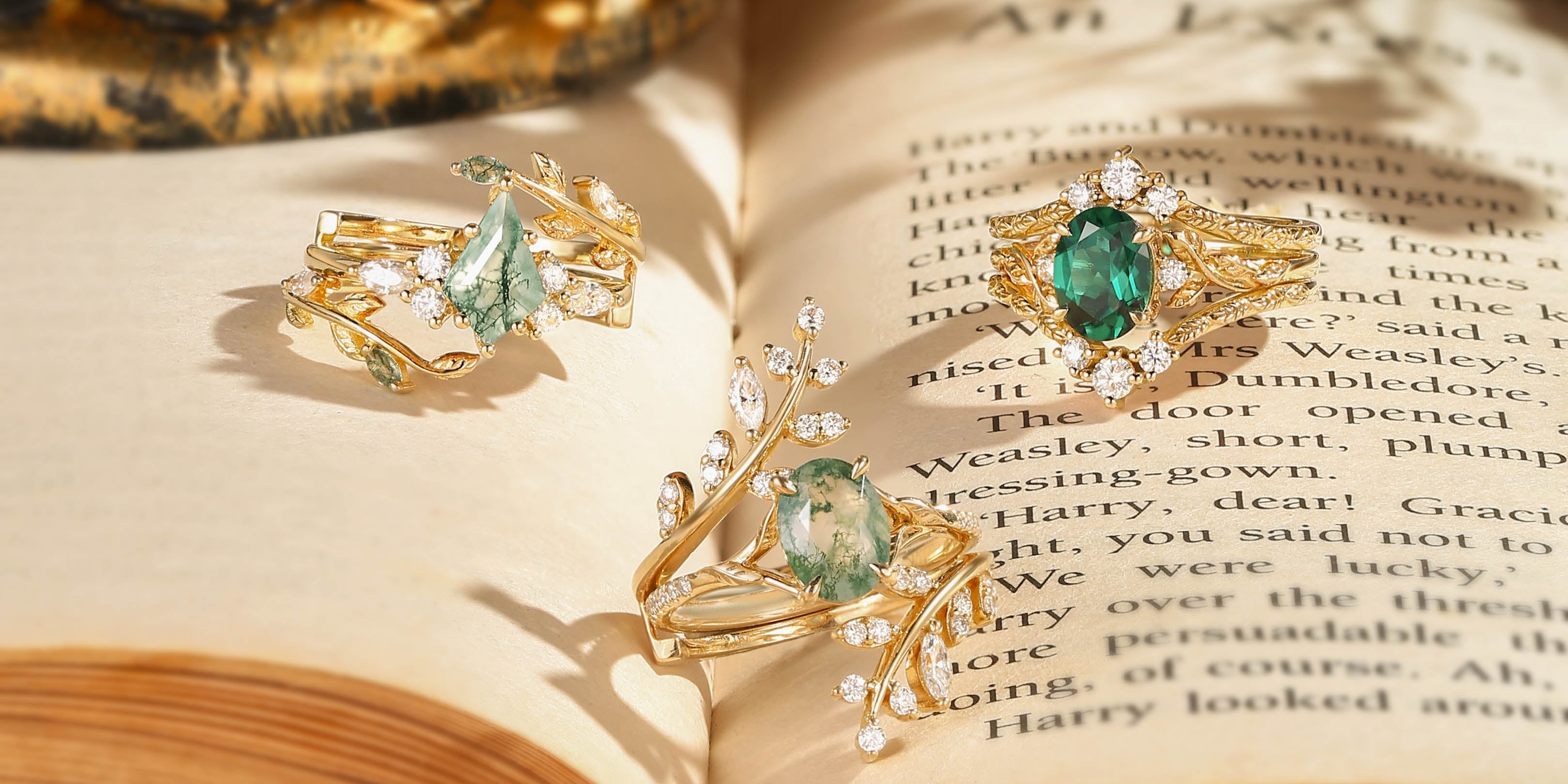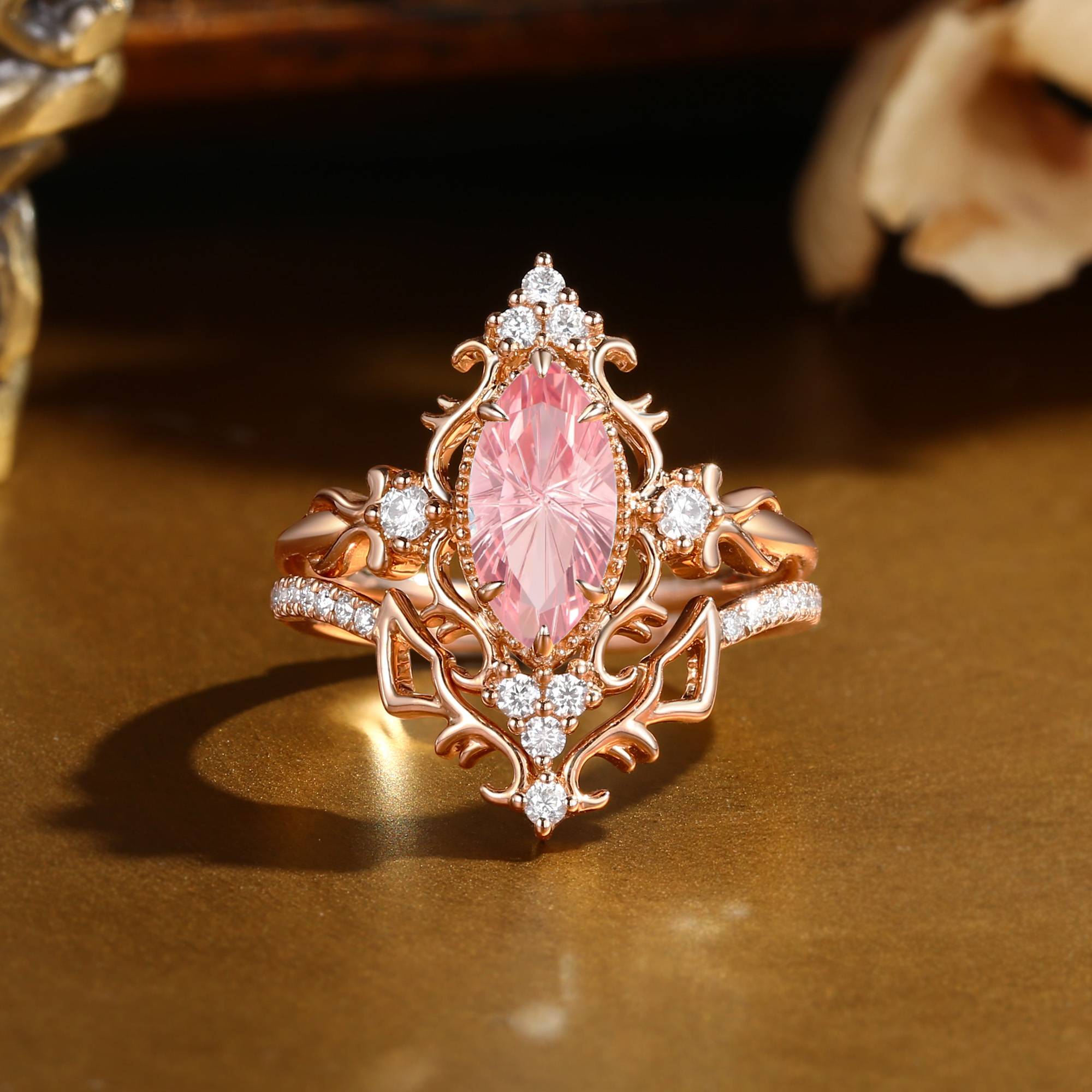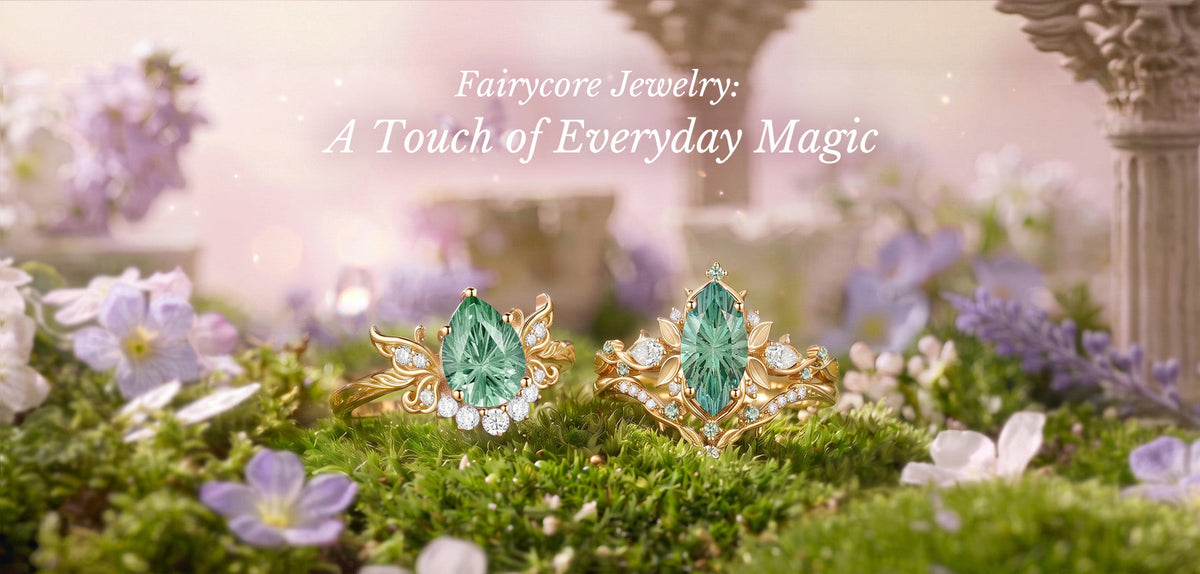
There is a quiet trend sweeping through bridal jewelry, and it goes by a name that sounds like it belongs in a storybook: fairycore. Part forest nymph, part modern minimalist who loves a leaf-shaped ring — fairycore jewelry captures the feeling of stepping into a clearing where the light falls just right and everything shimmers with possibility. If you have been searching for an engagement ring that feels less like a status symbol and more like a whispered promise, or a leaf ring that pairs as naturally with jeans as with a gown, you have found the aesthetic. The only question left is which piece to choose first.
At BlingFlare, we have watched the fairycore movement grow from a niche mood board into a genuine design philosophy — one that values organic shapes, hand-finished detail, and gemstones that echo the living world. In this guide, we will walk you through what fairycore jewelry really means, the nature-inspired details that define it, and how to weave a little everyday magic into your personal style. Let's begin.
Table of Contents
- The Enchantment of Fairycore Jewelry
- Inspired by Forests and Fairytales
- Nature's Details: Leaves, Vines & Gemstones
- A Touch of Magic in Everyday Life
- Discover BlingFlare's Enchanted Rings
The Enchantment of Fairycore Jewelry
Fairycore is, at its heart, a celebration of the small and the magical. It draws from the same wellspring as cottagecore and dark academia — a longing for slowness, for handcraft, for objects that feel like they carry a story. Where cottagecore leans toward quilts and wildflower baskets, fairycore tilts toward the enchanted: think morning dew on a spiderweb, moth wings caught in lamplight, the curve of a fern unfurling. In jewelry, that translates to designs that borrow directly from the natural world — twisted vine bands, leaf-shaped bezels, butterfly-wing filigree, and gemstones chosen for their organic color rather than their flawless symmetry. It is jewelry that whispers rather than shouts, that rewards a close look, that feels discovered rather than displayed.
The movement gained momentum during the early 2020s, when social media aesthetics began to reshape how people thought about personal style. Instead of defaulting to a classic solitaire because "that is what engagement rings look like," a new generation started asking: what does my ring look like? For many, the answer involved texture, movement, and a sense that the piece had grown rather than been manufactured. Fairycore jewelry answered that call. It offered something romantic without being saccharine, intricate without being fussy, and — perhaps most importantly — wearable on an ordinary Tuesday, not just at a gala.
What sets fairycore apart is its emphasis on whimsy with restraint. A fairycore ring is not a literal mushroom or a pair of glued-on wings. It is the suggestion of a forest — the curve of a tendril, the shadow of a leaf, the flash of green in dappled light. That subtlety is what makes the aesthetic so versatile. A well-designed fairycore piece can anchor a boho wedding look, complement a minimalist wardrobe, or sit quietly on your finger as a private reminder that the world still holds small wonders.
The bridal world has taken notice. Engagement rings with leafy vine settings, pear-cut stones that mimic dewdrops, and bands that twist like branches are among the most-requested designs at independent jewelers. Couples are drawn to the idea that their ring can be deeply personal and connected to something larger — the slow turning of seasons, the persistence of moss on stone, the quiet magic of a forest at dawn.
And here is the best part: you do not need a full fairycore wardrobe. A single leaf-shaped ring, a vine-patterned engagement band, gemstone studs that catch the light like morning sun through canopy — these small gestures bring the feeling into daily life. Fairycore is not about performance. It is about noticing.
Inspired by Forests and Fairytales
To understand why fairycore jewelry resonates so deeply, it helps to trace its roots — and those roots run into some of the oldest stories humans have ever told. Forests have always been places of transformation in mythology. In Celtic tradition, the forest was a threshold between the everyday world and the Otherworld, a place where mortals might encounter fairies and spirits of impossible beauty. In Germanic legend, enchanted woods were where heroes faced their deepest fears and emerged changed. In Japanese Shinto, ancient trees are considered sacred, home to spirits that inhabit the natural world. Across cultures, the forest is where magic lives.
Fairycore jewelry borrows from that tradition of enchantment, translating it into wearable form. The most common motifs are drawn directly from the understory: leaves, particularly ferns, oak, and eucalyptus; vines and tendrils, which twist around the finger like ivy climbing a garden wall; butterfly wings, whose delicate symmetry and iridescent color make them a natural fit for jewelry; and elven or fairy silhouettes — slender, winged figures that suggest grace and a connection to the unseen.
Each motif carries symbolism that makes fairycore pieces feel personal. Leaves represent growth and renewal. Vines speak to connection and resilience. Butterflies embody metamorphosis. And fairy or elven elements channel wonder — the belief that the world holds more than what we can see.
These symbols are not merely decorative. When you choose an engagement ring wrapped in vine-like filigree, you are embedding meaning into a piece you will wear for decades. That is why fairycore jewelry feels different from mass-produced accessories. It feels chosen.
The aesthetic also draws heavily from the Arts and Crafts movement of the late nineteenth century, when designers rejected rigid industrial symmetry in favor of organic forms inspired by insects, flowers, and flowing water. Modern fairycore continues that philosophy: jewelry should feel alive, move with the body, and echo the imperfect perfection of nature itself.


Nature's Details: Leaves, Vines & Gemstones
The soul of any fairycore piece lies in its details — and nowhere is that more apparent than in the choice of gemstone. Because this aesthetic is rooted in the natural world, the stones that feel most at home are those whose colors evoke forests, moss, morning light, and living things. That means green gemstones take center stage, supported by cutting styles designed to maximize their organic beauty.
Green sapphire is the cornerstone. Scoring a 9 on the Mohs hardness scale — second only to diamond — it is one of the few colored gemstones tough enough for daily wear without constant worry. Its color ranges from pale mint to deep forest, with some stones showing pleochroism, a shifting hue that can look olive in daylight and seafoam by candlelight. Green sapphires get their color from trace amounts of iron and chromium — the same elements that give the earth its greens. For brides seeking a stone that feels alive, green sapphire is hard to beat.
Moss agate offers a different kind of beauty entirely. A variety of chalcedony, moss agate contains mineral inclusions that create patterns resembling tiny landscapes. No two stones look alike; some appear to contain entire forests suspended in translucent quartz. While softer than sapphire (6.5–7 on the Mohs scale), its uniqueness makes it a favorite for one-of-a-kind fairycore designs, especially when paired with vine or leaf settings that echo its internal scenery.
Peridot, the birthstone for August, brings a brighter, more cheerful green. Its color comes from iron within the crystal structure itself — not from trace inclusions — which means even the palest peridot carries vivid, limey intensity. At 6.5–7 on the Mohs scale, it is best suited for occasional-wear pieces or protective settings. Peridot pairs beautifully with yellow gold and leaf-motif designs, lending a sun-dappled warmth to the fairycore aesthetic.
Emerald, the classic May birthstone, needs little introduction. Its deep green has symbolized rebirth for thousands of years. At 7.5–8 on the Mohs scale, emerald is softer and more inclusion-prone than sapphire, but its legendary color makes it a compelling choice for those who want a stone with history.
The cutting styles that best showcase these green gemstones are equally inspired by nature. Marquise cuts, with their elongated points, evoke the shape of a leaf — a natural fit for vine-wrapped settings. Pear cuts resemble dewdrops, lending themselves to designs where the stone appears to hang from a tendril. Kite cuts, with their angular geometry, offer a modern take on organic form, their faceted surfaces catching light like a leaf turned sideways in the sun. And then there is the firework cut, a specialty cut unique to nature-inspired jewelers, which scatters light into a radial burst pattern — as if the gem itself is blooming. If you want a ring that looks like no other, a firework-cut gemstone is a wonderful place to start.
| Gemstone | Mohs Hardness | Color Range | Cause of Color | Best For |
|---|---|---|---|---|
| Green Sapphire | 9 | Mint, olive, forest, teal | Iron, titanium, chromium traces | Everyday engagement rings; vine & leaf settings |
| Moss Agate | 6.5–7 | Translucent with green mineral inclusions | Hornblende or manganese dendrites | One-of-a-kind statement pieces; boho bridal |
| Peridot | 6.5–7 | Lime to olive green | Iron within crystal structure | Accent stones; yellow gold fairycore designs |
| Emerald | 7.5–8 | Deep saturated green | Chromium and/or vanadium | Heirloom pieces; classic & vintage settings |
The marriage of these gemstones with nature-inspired settings is what gives fairycore jewelry its unmistakable character. A marquise-cut green sapphire nestled in a band of twisted vines is not simply a ring — it is a small, wearable garden. That is the alchemy of fairycore design: it takes the raw materials of the earth and arranges them so that the wearer carries a piece of the living world wherever she goes.


A Touch of Magic in Everyday Life
The most beautiful ring in the world is useless if it sits in a drawer. One of the greatest strengths of fairycore jewelry is that it was designed to be worn in real life, not preserved behind glass. The aesthetic does not demand that you dress like a woodland creature to pull it off. A single fairycore ring, styled with intention, can elevate a simple outfit and bring a sense of quiet enchantment to an otherwise ordinary day.
Stacking is one of the most effective ways to incorporate fairycore into daily wear. A delicate vine band paired with a leaf-shaped engagement ring creates a layered, organic look that feels effortless. Mix metals for a modern twist — a rose gold leaf ring stacked with a yellow gold twisted band echoes the way different tones coexist in a forest understory. If your fairycore piece features a colored gemstone, let it be the focal point and keep surrounding bands simple. The goal is harmony, not competition.
Skin tone and metal pairing also play a role. Cool-toned skin (pink or bluish undertones) makes mint and seafoam-green gemstones sing in white gold or platinum. Warm-toned skin (golden or olive undertones) flatters deeper greens — olive, forest, sage — against yellow or rose gold. Neutral skin tones pull off nearly any combination. If you are unsure, try your ring on in natural daylight and observe how the metal and stone interact with your skin. The right pairing will feel intuitive.
Subtle fairy vs. full statement is another spectrum to explore. Some days, you may want your jewelry to whisper — a thin vine band with a tiny green sapphire accent, barely visible unless someone is looking closely. Other days, you may want it to sing — a bold marquise-cut stone wrapped in leaf filigree, catching the light from across the room. The beauty of the fairycore aesthetic is that it supports both. Wear it with a linen dress and sandals for a soft romantic look, or with a tailored blazer and minimalist earrings for a juxtaposition of structure and whimsy that feels thoroughly modern.
Practical considerations matter too. If you work with your hands — gardening, cooking, typing — consider a ring with a lower profile setting that will not snag. Bezel-set or partially protected gemstones suit active lifestyles. And fairycore's organic, hand-finished texture works in your favor: small scratches and wear marks blend into the vine-and-leaf pattern over time, giving the piece a lived-in character that feels earned rather than damaged.
Ultimately, fairycore jewelry is about permission — permission to wear something beautiful simply because it makes you happy, not because it signals a particular status. A ring that looks like it grew from the earth is a reminder that you are part of something natural and ongoing. That is magic worth wearing every day.


Discover BlingFlare's Enchanted Rings
At BlingFlare, fairycore is not a trend we jumped on — it is a philosophy we have been building toward since the beginning. Our design language has always drawn from the natural world: the twist of a vine, the shadow of a fern, the way light filters through a canopy. Every ring in our collection is designed to feel like it belongs to the forest, even if it ends up on a hand in the middle of a city. We believe that jewelry should carry a story, and ours begins with the quiet conviction that the most beautiful things are those that echo the living world.
We work primarily with lab-grown gemstones — stones that are chemically, optically, and physically identical to their mined counterparts, but with a known origin and a lighter environmental footprint. For couples who value transparency and sustainability, lab-grown stones offer the beauty of the earth without the ethical uncertainty. Every gemstone in our collection is hand-selected and verified by our team before it becomes part of a design. We choose each stone for its depth of color, its cut quality, and its ability to catch light in a way that feels alive. For those who prefer natural stones, we also offer genuine mined sapphire designs.
We also want the experience of buying from us to feel as considered as the rings themselves. Here is how we handle the practical side:
- Free resizing for one year: We offer one free ring resizing within one year of purchase, up to ±1 size.
- 30-day returns for quality issues: If something is wrong with your ring due to a manufacturing defect, you may return it within 30 days.
- Change-of-mind returns: For personal (non-quality) reasons, returns are accepted with a 30% deduction.
- Custom and engraved pieces: Custom-made and engraved rings are final sale and cannot be returned.
Have a design in mind that you have not seen in our collections? Our team loves a creative challenge. Whether it is a specific gemstone cut, a particular vine or leaf pattern, or an engraving that means something only you understand, we are here to help you bring it to life.


Frequently Asked Questions
What is fairycore jewelry?
Fairycore jewelry is a design aesthetic inspired by forests, fairytales, and the enchanted natural world. It features organic motifs like leaves, vines, butterflies, and elven details, often set with green gemstones that echo moss, ferns, and forest light. The style emphasizes whimsy with restraint — pieces that feel magical but remain wearable in everyday life.
What gemstones suit the fairycore aesthetic?
Green gemstones are the cornerstone of fairycore jewelry. Green sapphire, moss agate, peridot, and emerald all evoke the natural world beautifully. Moonstone and labradorite are also popular choices for their ethereal, otherworldly glow. The unifying principle is that the stone should feel like it belongs in a forest — organic in color, rich in character, and alive with light.
Which metal works best with fairycore rings?
All three classic jewelry metals work beautifully, depending on the mood you want. Yellow gold warms the piece for a romantic, vintage feel. White gold and platinum cool it for a more modern, icy aesthetic. Rose gold adds a soft blush that complements olive and sage-toned gemstones. There is no wrong choice — only the one that matches your personal style.
Are lab-grown gemstones as good as natural ones for fairycore designs?
Yes. Lab-grown gemstones are chemically, optically, and physically identical to their mined counterparts. They offer the same beauty, durability, and color — with the added benefits of a known origin and a lighter environmental footprint. For fairycore jewelry, which celebrates the natural world, many couples find that lab-grown stones align beautifully with their values.
How do I clean a fairycore ring with delicate details?
Warm water, a mild dish soap, and a soft-bristled toothbrush are all you need. Gently scrub around the setting and any filigree or vine details, rinse thoroughly, and pat dry with a soft cloth. Avoid harsh chemicals and ultrasonic cleaners if your ring has delicate hand-finished details or soft gemstone accents like pearl or moonstone.
Can fairycore jewelry be customized?
Yes. Many jewelers, including BlingFlare, offer custom design services for fairycore-inspired pieces. Whether you want a specific gemstone cut, a particular vine or leaf pattern, or a meaningful engraving, a skilled jeweler can bring your vision to life. Keep in mind that custom and engraved pieces are typically final sale, so it is worth confirming the design details carefully before committing.
Ready to find the piece that feels like it was grown just for you? Browse our fairy rings collection or explore our nature-inspired designs, and let BlingFlare help you carry a touch of everyday magic wherever you go.